

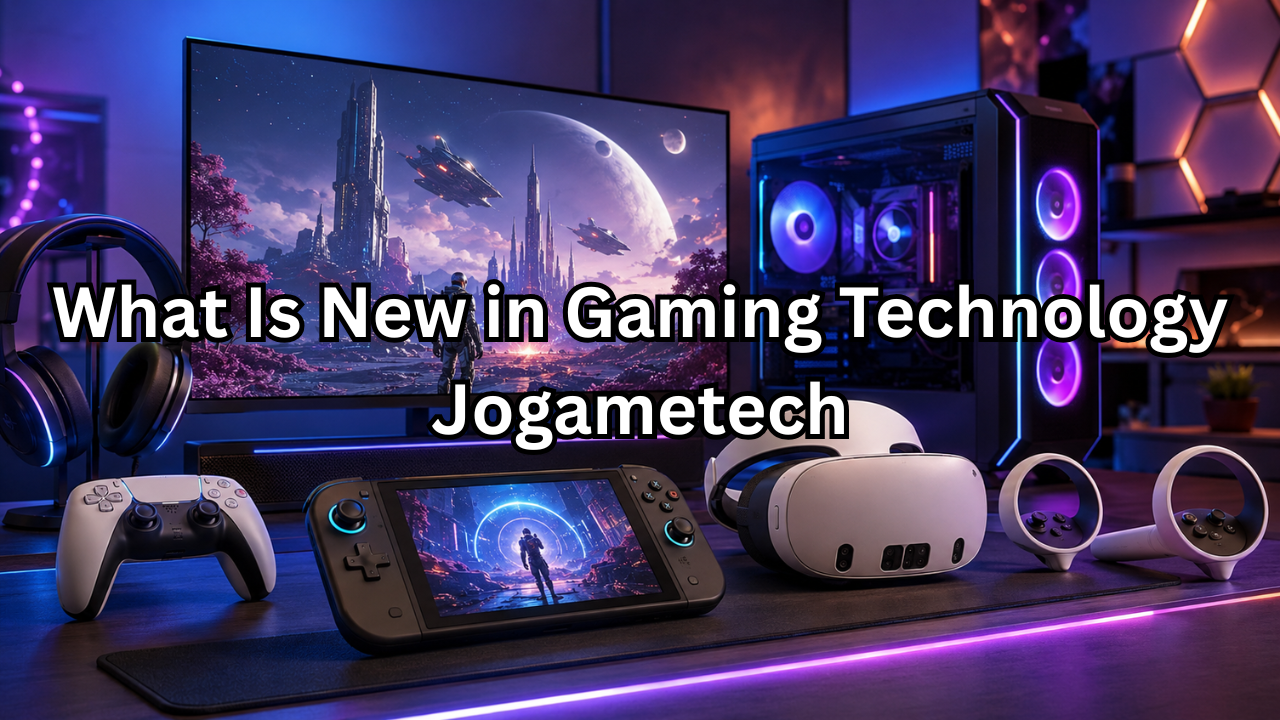
Gaming technology is moving faster than ever. New graphics techniques, smarter artificial intelligence, faster storage, cloud platforms, immersive hardware, and better controllers are changing what players expect from modern games.
If you are searching for what is new in gaming technology jogametech, the answer goes far beyond better graphics. Today’s biggest developments are focused on making games more responsive, immersive, intelligent, accessible, and connected.
The gaming industry is gradually moving away from simply increasing resolution and frame rates. Developers and hardware companies are looking at how games behave, how quickly they respond to players, and how naturally digital worlds can react to individual actions.
This guide explores the most important gaming technology developments and explains what they mean for everyday players.
Gaming Technology Is Moving Beyond Better Graphics
For years, gaming upgrades were mainly measured by resolution, texture quality, frame rate, and visual effects. Those things still matter, but they are no longer the whole story.
Modern gaming technology is becoming more interactive.
A game can now use machine learning to improve visual quality, sophisticated networking to reduce delays, advanced physics to create more believable environments, and high-speed storage to make large worlds feel almost seamless.
This shift is important because players can actually feel many of these improvements.
A smoother response when pressing a button can make a competitive game feel better. Faster loading can make exploration more enjoyable. Smarter enemies can make a single-player campaign less predictable.
In other words, gaming innovation is increasingly about the complete experience.

AI Is Becoming One of Gaming’s Biggest Technologies
Artificial intelligence is one of the most talked-about developments in gaming.
However, its role is broader than simply creating chatty NPCs.
AI and machine-learning techniques can assist developers with animation, testing, asset creation, procedural content, dialogue systems, and game balancing. Developers can potentially spend less time on repetitive production work and more time refining gameplay.
AI can also influence the player’s experience.
Imagine an enemy system that analyzes your repeated strategies and changes its behavior instead of following the same predictable pattern every time. Or consider NPCs that can respond more naturally to different situations.
These ideas are helping developers explore games that feel more dynamic.
How AI Could Change Gameplay
Some of the most interesting possibilities include:
- More responsive NPC behavior
- Adaptive enemy difficulty
- Procedurally generated environments
- Faster animation and asset production
- More natural character dialogue
- Personalized game experiences
- Improved game testing and quality assurance
The technology still has limitations. AI-generated content can sometimes feel repetitive or inconsistent, and developers need strong creative direction to keep a game coherent.
Still, AI is clearly becoming an important part of the gaming development process.
Real-Time Ray Tracing Is Becoming More Practical
Ray tracing is no longer just a technology used to create impressive demonstrations.
Modern graphics hardware has made real-time ray tracing increasingly practical for games. The technology can produce more realistic reflections, shadows, lighting, and environmental effects.
The challenge has always been performance.
Ray tracing requires substantial processing power, which can reduce frame rates when used heavily. Modern upscaling and frame-generation technologies are helping developers balance visual quality with performance.
This means gamers can increasingly enjoy advanced lighting without sacrificing as much smoothness as they might have in earlier implementations.
The result is especially noticeable in games featuring reflective surfaces, nighttime environments, realistic indoor lighting, and detailed weather effects.
AI-Powered Upscaling Is Changing Performance
One of the most useful developments in modern PC gaming is intelligent image reconstruction.
Instead of rendering every frame at the monitor’s full native resolution, supported technologies can render at a lower internal resolution and reconstruct the image using sophisticated algorithms.
The goal is straightforward: deliver better performance while keeping the picture looking sharp.
This can be particularly useful when playing demanding games with ray tracing enabled.
For gamers, the benefit is practical. A system that struggles to maintain a high frame rate at native resolution may deliver a much smoother experience using an appropriate upscaling mode.
However, image reconstruction is not magic. Quality can vary depending on the game, settings, movement, and implementation.
Cloud Gaming Continues to Improve
Cloud gaming is another major part of the conversation surrounding what is new in gaming technology jogametech.
Instead of requiring the player’s device to render the entire game locally, cloud platforms can run games on remote servers and stream the resulting experience to a compatible device.
This creates an interesting possibility: expensive gaming hardware becomes less important for certain players.
A lightweight laptop, television, tablet, or other supported device can potentially access games that would otherwise require a much more powerful machine.
Cloud gaming still depends heavily on internet quality.
Connection stability, latency, bandwidth, server distance, and network congestion can all affect the experience. Competitive players may still prefer local hardware because even small delays can matter.
But for casual gaming and people who want convenient access to large game libraries, cloud technology continues to be an important development.
Faster SSDs Are Transforming Game Design
Solid-state storage has changed gaming in a major way.
Traditional hard drives are much slower at accessing data than modern NVMe SSDs. Faster storage allows games to load assets more quickly and reduces the waiting time between areas.
The impact goes beyond shorter loading screens.
Developers can design large environments with more seamless transitions because the system can retrieve game assets faster.
This can help create worlds that feel more connected.
Instead of using long corridors, elevators, or artificial pauses to hide loading processes, developers have more opportunities to move players between different areas without obvious interruptions.
As storage technology becomes faster and more common, game worlds can become increasingly detailed and continuous.
Haptic Feedback Makes Games More Physical
Gaming controllers are also evolving.
Modern haptic systems can provide much more detailed feedback than traditional vibration motors. Different types of actions can produce different sensations, giving players additional information through their hands.
For example, a controller might communicate:
- Weapon recoil
- Road surfaces
- Environmental effects
- Character movement
- Resistance from an in-game object
- Changes in acceleration
This can make an experience more immersive without requiring another screen.
The technology can also have functional benefits. Instead of relying entirely on visual or audio information, players can sometimes receive useful feedback through touch.
That makes haptics more than a simple novelty.
Virtual Reality and Mixed Reality Are Still Evolving
Virtual reality has been promising to transform gaming for years, but the technology is still developing.
Modern headsets are becoming more capable, with improved displays, tracking, processing, controllers, and mixed-reality features.
Mixed reality is particularly interesting because it combines digital content with the physical environment.
Rather than completely replacing the real world, a mixed-reality system can place digital objects into a player’s surroundings.
This creates new possibilities for puzzle games, fitness experiences, social gaming, simulations, and interactive entertainment.
The biggest challenges remain comfort, battery life, pricing, content availability, and the amount of time people are willing to wear a headset.
VR may not replace traditional gaming, but it is likely to remain an important part of the industry’s experimentation.
Portable Gaming Is Becoming More Powerful
Handheld gaming has experienced a major transformation.
Modern portable devices can run games that once required a traditional desktop or console. More capable processors, integrated graphics, efficient cooling, fast storage, and improved displays have made portable PC gaming increasingly practical.
This changes where people can play.
A gamer no longer has to choose exclusively between a desktop and a conventional console. Portable devices can provide access to large game libraries while offering more flexibility.
The biggest challenge is battery life.
Powerful hardware requires energy, so manufacturers continue to balance performance against efficiency. Better chips and operating-system optimization will be important as portable gaming continues to grow.
Controllers Are Becoming More Customizable
Another trend is the growth of advanced input devices.
Modern controllers can include features such as:
- Adjustable triggers
- Remappable buttons
- Replaceable sticks
- Different stick tension options
- Additional rear buttons
- Motion controls
- Improved ergonomic designs
These features are particularly valuable for competitive players.
A customizable controller can also improve accessibility by allowing players to configure controls around their individual needs.
This reflects a broader trend in gaming: hardware is becoming less standardized and more personalized.
Gaming Technology Is Improving Accessibility
Accessibility is an increasingly important area of gaming technology.
Developers are adding options that allow more players to enjoy games regardless of physical, visual, auditory, or cognitive limitations.
Examples can include:
- Custom control layouts
- Button remapping
- Subtitles and visual indicators
- Adjustable difficulty
- Color and contrast options
- One-handed control solutions
- Audio customization
- Simplified input systems
Accessibility features benefit more than a single group of players.
A player may temporarily need a different control arrangement, prefer larger interface elements, or simply find one input method more comfortable than another.
Better accessibility ultimately gives players more control over how they experience a game.
Game Engines Are Becoming More Capable
Modern game engines are another important part of the technology story.
Game engines provide developers with tools for graphics, physics, animation, audio, networking, lighting, and world creation.
Advanced engines can help studios create increasingly complex environments while supporting multiple platforms.
Procedural generation and automation can also help teams build large worlds more efficiently.
This is especially significant for smaller studios. Powerful development tools can allow relatively small teams to create ambitious projects without having to build every technology component from scratch.
The result could be more variety in the gaming market.
How the Major Gaming Technology Trends Compare
| Technology | Main Benefit | Biggest Challenge | Player Impact |
|---|---|---|---|
| Artificial Intelligence | Smarter systems and faster development | Consistency and creative control | More dynamic experiences |
| Ray tracing | More realistic lighting | Performance requirements | Better visual realism |
| AI upscaling | Higher performance | Image-quality compromises | Smoother gameplay |
| Cloud gaming | Gaming without powerful local hardware | Latency and internet quality | Greater accessibility |
| NVMe SSDs | Faster data access | Cost and storage capacity | Shorter loading and smoother worlds |
| Haptics | More detailed physical feedback | Hardware support | Greater immersion |
| VR/MR | More immersive interaction | Comfort and price | New gameplay formats |
| Portable gaming | Gaming on the move | Battery life | More flexibility |
| Adaptive controllers | Personalized controls | Cost and compatibility | Better accessibility |
What These Changes Mean for Everyday Gamers
The most important point is that you do not need every new technology to enjoy modern gaming.
Technology upgrades should solve an actual problem.
If games take too long to load, a faster SSD may provide a noticeable improvement. If your system struggles with demanding graphics, an appropriate upscaling technology may help.
If you mainly play competitive games, low input latency and a high-refresh-rate display could matter more than advanced lighting.
For players interested in immersive experiences, haptics or VR may provide more meaningful improvements.
The best upgrade depends on how you play.

What Should Gamers Watch Next?
The next stage of gaming technology will probably focus on combining several technologies rather than relying on one breakthrough.
AI may work alongside advanced graphics. Cloud infrastructure may work with local processing. Haptics may become more sophisticated. Portable devices may become more efficient.
We may also see games become more personalized.
Instead of every player receiving exactly the same experience, future systems could potentially adjust difficulty, content, environments, or NPC behavior based on individual gameplay.
That could make replayability much more interesting.
At the same time, developers will need to think carefully about privacy, cost, performance, and responsible use of AI.
Technology is powerful, but good game design still matters most.
Frequently Asked Questions
What is new in gaming technology Jogametech?
The phrase refers broadly to the latest developments shaping modern gaming, including AI, advanced graphics, cloud gaming, faster storage, haptic feedback, VR, portable hardware, and improved input systems.
How is AI changing video games?
AI can assist with game development, animation, testing, procedural content, dialogue, and adaptive gameplay. Its long-term impact will depend on how effectively developers use it without sacrificing creative quality.
Is ray tracing worth using for gaming?
It can be worthwhile if you value realistic lighting and reflections. However, ray tracing can reduce performance, so gamers may need to balance graphical quality with frame rate.
Is cloud gaming better than owning gaming hardware?
Not necessarily. Cloud gaming offers convenience and can reduce the need for expensive hardware, but it depends on a reliable internet connection. Local hardware generally provides more control and can offer lower latency.
Are SSDs important for modern gaming?
Yes. Fast SSDs can significantly reduce loading times and help developers create larger, more seamless game worlds. They are now an important part of many modern gaming systems.
Will VR replace traditional gaming?
There is little reason to assume that VR will completely replace traditional gaming. Instead, VR and mixed reality are more likely to develop alongside consoles, PCs, handhelds, and mobile gaming.
Final Thoughts
So, what is new in gaming technology jogametech?
The biggest change is that gaming innovation is no longer focused exclusively on making games look prettier. The industry is working toward experiences that are faster, smarter, more responsive, immersive, and personalized.
Artificial intelligence is influencing development and gameplay. Ray tracing is improving visual realism. Upscaling technologies are helping hardware deliver better performance. SSDs are making large worlds more seamless, while haptics and VR are changing how players interact with digital environments.
Portable systems are also making powerful gaming more flexible, while accessibility improvements are helping more people participate.
The exciting part is that these technologies are developing at the same time.
For gamers, that means the future is not about buying every new device. It is about understanding which innovations actually improve the way you play.
The gaming industry is entering a period where technology is becoming less visible but more influential. Instead of simply adding flashy features, the best innovations are working quietly in the background to make games feel faster, smarter, and more natural.
That is where the next generation of gaming is likely to make its biggest impact.
Also Read : Kalon AI: A Complete Guide to the AI Companion Platform in 2026









Leave a Reply