

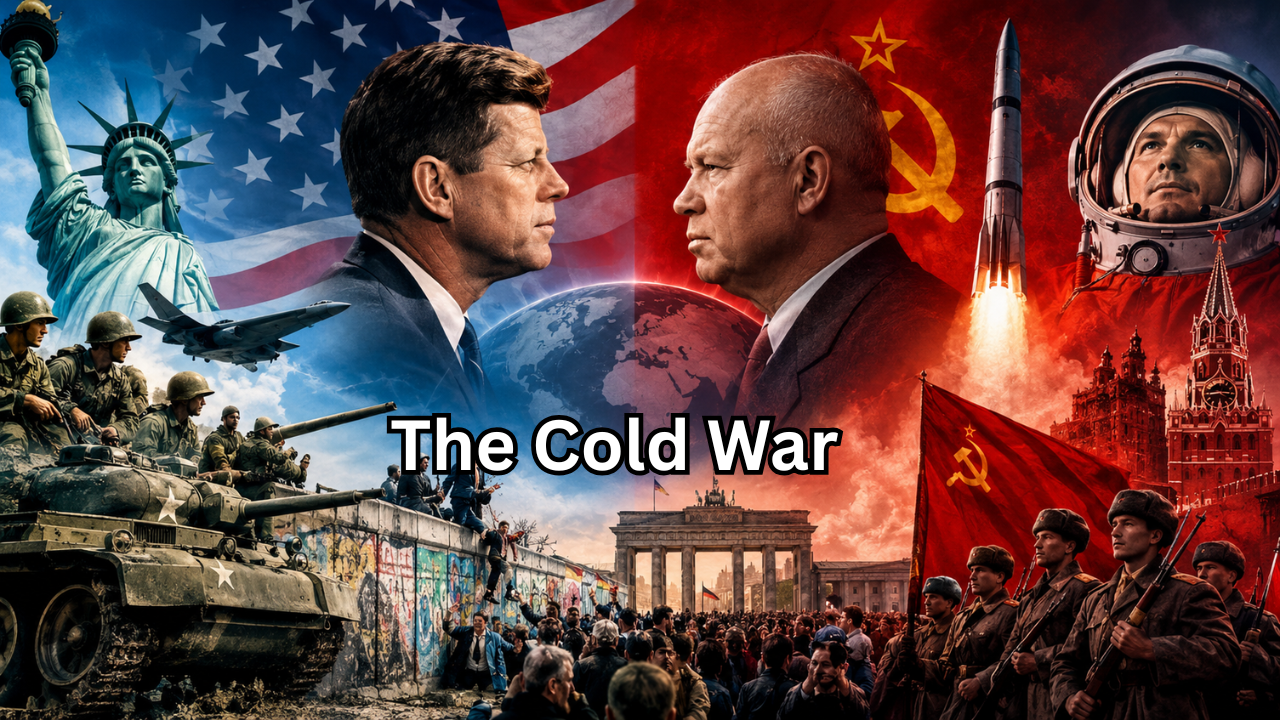
The Cold War was one of the most important geopolitical struggles of the 20th century. Unlike the two world wars, it was not fought through a continuous direct military confrontation between the world’s two most powerful rivals. Instead, the conflict involved political pressure, military alliances, nuclear weapons, espionage, economic competition, propaganda, technological rivalry, and wars fought indirectly through other countries.
The Cold War mainly developed between the United States and its allies and the Soviet Union and countries aligned with it after World War II. Although the two superpowers rarely fought each other directly, their competition shaped international relations for more than four decades.
From the division of Europe to the Cuban Missile Crisis, the Korean War, the Vietnam War, the Space Race, and the fall of the Berlin Wall, the Cold War influenced millions of lives. Its effects can still be seen in international politics, military alliances, nuclear policy, and relations between major world powers.
Understanding the Cold War helps explain how the modern international system developed and why many political tensions of the second half of the 20th century took the form they did.
What Was the Cold War?
The Cold War was a prolonged period of political, military, economic, and ideological rivalry between the United States and the Soviet Union. Historians generally place its beginning in the years immediately following World War II, although there is debate over the exact starting point.
The conflict was called a “cold” war because the United States and Soviet Union did not engage in a sustained direct war against each other. Both possessed enormous military capabilities, particularly nuclear weapons, which made a direct confrontation extremely dangerous.
Instead, competition occurred in many other ways.
The two sides:
- Built powerful military alliances.
- Expanded their nuclear arsenals.
- Supported opposing governments and movements.
- Used intelligence agencies for espionage and covert operations.
- Competed in science and technology.
- Used propaganda to promote their political systems.
- Supported opposing sides in conflicts around the world.
- Competed for influence in Europe, Asia, Africa, Latin America, and the Middle East.
At the center of the Cold War was a fundamental ideological disagreement. The United States generally promoted capitalism and liberal democratic institutions, while the Soviet Union promoted a communist political and economic system under the leadership of the Communist Party.
Why Did the Cold War Begin?
The origins of the Cold War were complex. There was no single event that suddenly created the conflict. Instead, tensions developed from disagreements that became increasingly serious after World War II.
Ideological Differences
The United States and Soviet Union represented very different political and economic models.
The United States supported private enterprise, market-based economics, and democratic government. The Soviet Union operated under a communist system in which the state played a dominant role in economic life and political power was concentrated within the Communist Party.
These differences created mutual suspicion.
Each side feared that the other wanted to expand its influence around the world. As countries recovered from World War II, both superpowers attempted to shape the political future of Europe and other regions.
The Division of Europe
World War II left much of Europe economically devastated and politically unstable.
Soviet forces occupied much of Eastern Europe as the war ended. Communist governments subsequently emerged across several countries in the region.
Western governments became increasingly concerned about Soviet expansion. The Soviet leadership, meanwhile, viewed a strong Soviet sphere in Eastern Europe as an important security buffer after the enormous destruction suffered during World War II.
Europe gradually became divided into competing political and military blocs.
The Nuclear Arms Race
The United States used atomic bombs against Hiroshima and Nagasaki in 1945. The Soviet Union successfully tested its own atomic bomb in 1949.
The development of nuclear weapons transformed the rivalry.
Both sides began building increasingly powerful nuclear arsenals. The possibility of a nuclear war created a dangerous form of deterrence in which each side understood that a major attack could lead to catastrophic retaliation.
This concept became closely associated with mutually assured destruction, often abbreviated as MAD.
Major Differences Between the United States and Soviet Union
| Feature | United States | Soviet Union |
|---|---|---|
| Political system | Federal democratic republic | Communist one-party state |
| Economic model | Capitalist market economy | Centrally planned economy |
| Major alliance | NATO | Warsaw Pact |
| Main ideology | Liberal democracy and capitalism | Marxism-Leninism and communism |
| Military strategy | Nuclear deterrence and global alliances | Nuclear deterrence and regional/global influence |
| Major rival | Soviet Union | United States |
This rivalry was not simply about military power. It was also a competition over which political and economic model would have greater international influence.
Major Events of the Cold War
The Cold War lasted for decades and included numerous crises and conflicts. Some events became defining moments of the era.
The Truman Doctrine
In 1947, U.S. President Harry Truman announced a policy that became known as the Truman Doctrine.
The United States pledged to support countries threatened by authoritarian or communist movements. The policy became an important foundation of American Cold War strategy.
The Marshall Plan
The United States introduced the Marshall Plan in 1948 to provide substantial economic assistance for European recovery after World War II.
American policymakers viewed economic recovery as important for political stability. The Soviet Union rejected participation and discouraged Eastern European governments under its influence from taking part.
The resulting economic divide reinforced the growing separation between Western and Eastern Europe.
The Berlin Blockade and Airlift
Berlin became one of the earliest major confrontations of the Cold War.
In 1948, the Soviet Union blocked Western land access to West Berlin. The United States and its allies responded by organizing a massive airlift to deliver food, fuel, and other necessities to the city’s population.
The blockade eventually ended in 1949.
The crisis demonstrated how quickly disagreements between the superpowers could become international confrontations without developing into direct war between them.
The Formation of NATO
The North Atlantic Treaty Organization, commonly known as NATO, was established in 1949.
Its members agreed that an armed attack against one member would be treated as a matter of collective defense. The alliance became a central part of Western security policy during the Cold War.
The Korean War
The Korean War began in 1950 when North Korean forces crossed into South Korea.
The conflict quickly became international. The United States and other countries supported South Korea, while China intervened on the side of North Korea. The Soviet Union also supported North Korea.
The war ended with an armistice in 1953 rather than a comprehensive peace treaty. The Korean Peninsula remained divided.
The conflict demonstrated how Cold War competition could turn into a devastating armed conflict involving other nations.
The Warsaw Pact
In 1955, the Soviet Union and several Eastern European allies established the Warsaw Pact.
It functioned as the major military counterpart to NATO in Europe.
The creation of the two alliances strengthened the division of the continent into competing military blocs.
The Space Race
The Cold War extended beyond traditional military competition.
The United States and Soviet Union competed to demonstrate technological and scientific superiority through space exploration.
The Soviet Union achieved an early milestone in 1957 when it launched Sputnik 1, the world’s first artificial satellite.
In 1961, Soviet cosmonaut Yuri Gagarin became the first human to orbit Earth.
The United States later achieved one of the most famous accomplishments of the Space Race when Apollo 11 astronauts landed on the Moon in 1969.
The Space Race had practical consequences as well. Technologies developed during the period contributed to advances in communications, computing, aerospace engineering, and scientific research.
The Cuban Missile Crisis
The Cuban Missile Crisis of October 1962 was arguably one of the most dangerous moments of the Cold War.
The Soviet Union placed nuclear missiles in Cuba, only a short distance from the United States. American officials discovered the missile installations, and President John F. Kennedy’s administration demanded their removal.
For several days, the world faced the possibility of a nuclear confrontation.
Eventually, the Soviet Union agreed to remove the missiles from Cuba. The United States publicly committed not to invade Cuba and secretly agreed to remove American Jupiter missiles from Turkey.
The crisis demonstrated the risks of nuclear brinkmanship and encouraged both superpowers to establish stronger mechanisms for communication and arms control.
The Vietnam War
Vietnam became another major arena of Cold War competition.
The United States supported South Vietnam, while North Vietnam received support from the Soviet Union and China.
The conflict lasted for years and resulted in enormous human suffering and destruction.
The United States eventually withdrew its forces, and North Vietnam captured Saigon in 1975. Vietnam was subsequently unified under a communist government.
The Vietnam War also had a major effect on American domestic politics and public attitudes toward foreign intervention.
The Berlin Wall
In 1961, East German authorities constructed the Berlin Wall to prevent people from crossing from East Berlin into West Berlin.
The wall became one of the most recognizable physical symbols of the Cold War.
For nearly three decades, it represented the political and ideological division between East and West.
When the Berlin Wall opened in November 1989, it became a powerful symbol that the Cold War order was beginning to collapse.
The Role of Espionage
Intelligence gathering was another major part of the Cold War.
American and Soviet intelligence organizations attempted to obtain information about military capabilities, political plans, scientific research, and technological developments.
The CIA and KGB became two of the best-known intelligence organizations associated with the era.
Espionage often involved recruiting informants, intercepting communications, monitoring military activity, and conducting covert operations.
Popular culture frequently portrayed Cold War spies as dramatic action figures, but real intelligence work often depended on patient information gathering and analysis.
The Nuclear Arms Race
Nuclear weapons remained at the heart of the Cold War.
Both superpowers developed increasingly sophisticated nuclear systems, including:
- Intercontinental ballistic missiles.
- Submarine-launched ballistic missiles.
- Strategic bombers.
- Nuclear warheads with greater destructive capacity.
- Early-warning systems.
- Missile defense technologies.
The goal was not necessarily to use these weapons but to make the other side believe that a nuclear attack would result in unacceptable retaliation.
Arms-control agreements eventually attempted to limit some aspects of the nuclear competition.
The Strategic Arms Limitation Talks, or SALT, and later agreements reflected growing recognition that unlimited nuclear competition posed enormous risks.
Détente: A Period of Reduced Tension
The Cold War was not equally intense throughout its entire history.
During the late 1960s and 1970s, the United States and Soviet Union entered a period known as détente, a French term meaning relaxation of tensions.
The two countries negotiated arms-control agreements and expanded diplomatic contacts.
However, détente did not end the broader rivalry. Competition continued in different parts of the world, and tensions increased again toward the end of the 1970s.
How Did the Cold War End?
The Cold War did not end through a single treaty or battle.
Several developments contributed to its conclusion.
Soviet leader Mikhail Gorbachev, who came to power in 1985, introduced major reforms known as glasnost and perestroika. These reforms aimed to address serious political and economic problems within the Soviet system.
Gorbachev also pursued improved relations with the United States and reduced Soviet military involvement in Eastern Europe.
Meanwhile, communist governments across Eastern Europe faced growing domestic opposition and political change.
In 1989, the Berlin Wall fell.
Over the next two years, communist governments across Eastern Europe collapsed or underwent major political transformations.
In December 1991, the Soviet Union dissolved into 15 independent states.
The dissolution of the Soviet Union is generally regarded as the endpoint of the Cold War.
Major Figures of the Cold War
Many political leaders played important roles during the conflict.
Harry Truman
U.S. President Harry Truman helped establish early American Cold War policies, including the Truman Doctrine.
Joseph Stalin
Soviet leader Joseph Stalin shaped the Soviet Union’s postwar security strategy and played a major role in the early development of the Cold War.
John F. Kennedy
Kennedy’s presidency included the Cuban Missile Crisis, one of the most dangerous confrontations between the United States and Soviet Union.
Nikita Khrushchev
Khrushchev led the Soviet Union during several major Cold War events, including the Cuban Missile Crisis and the early stages of the Space Race.
Ronald Reagan
U.S. President Ronald Reagan took a strongly confrontational approach toward the Soviet Union during much of the 1980s while also eventually engaging in arms-control negotiations with Gorbachev.
Mikhail Gorbachev
Gorbachev introduced reforms within the Soviet Union and pursued improved relations with the West. His policies coincided with major political changes across Eastern Europe and the eventual dissolution of the Soviet Union.
The Global Impact of the Cold War
The effects of the Cold War extended far beyond Europe and North America.
Countries across Asia, Africa, Latin America, and the Middle East often became important locations for superpower competition.
Some governments received economic or military assistance from one side or the other. In other cases, local conflicts became connected to the larger ideological struggle.
The Cold War therefore affected:
- International diplomacy.
- Military spending.
- Nuclear weapons policy.
- Scientific research.
- Space exploration.
- Foreign aid.
- Intelligence operations.
- International trade.
- Domestic politics.
- Popular culture.
Millions of people experienced wars and political upheaval connected directly or indirectly to Cold War competition.
Why Does the Cold War Still Matter?
Although the Cold War ended decades ago, its legacy remains important.
NATO continues to exist, while nuclear weapons remain a central part of international security discussions.
The political borders and institutions created during the Cold War also continue to influence diplomacy.
The period also provides important lessons about nuclear deterrence, international alliances, ideological conflict, intelligence gathering, and the dangers of escalation.
For students of history and international relations, the Cold War is especially useful for understanding why modern global politics developed in its current form.
Frequently Asked Questions About the Cold War
When did the Cold War begin?
The Cold War is generally considered to have emerged after World War II, particularly during the late 1940s. Historians sometimes disagree about the precise starting point because tensions between the United States and Soviet Union developed gradually.
When did the Cold War end?
The Cold War is generally considered to have ended around 1991, when the Soviet Union dissolved. The fall of the Berlin Wall in 1989 was another major milestone in the collapse of the Cold War system.
Why was it called the Cold War?
It was called the Cold War because the United States and Soviet Union did not fight a prolonged direct war against each other. Instead, they competed through alliances, nuclear deterrence, espionage, political pressure, economic programs, technology, propaganda, and conflicts involving other countries.
What was the main cause of the Cold War?
There was no single cause. Major factors included ideological differences between capitalism and communism, disagreements over postwar Europe, Soviet influence in Eastern Europe, American containment policies, mutual distrust, and the development of nuclear weapons.
What was the Cuban Missile Crisis?
The Cuban Missile Crisis was a 1962 confrontation involving the United States, Soviet Union, and Cuba after the United States discovered Soviet nuclear missile installations in Cuba. The crisis lasted about 13 days and is widely regarded as one of the most dangerous moments of the nuclear age.
How did the Cold War affect the world?
The Cold War influenced international alliances, military strategy, nuclear weapons development, space exploration, foreign policy, intelligence operations, and conflicts in countries around the world. Its political and military legacy continues to influence international affairs.
Final Thoughts
The Cold War was far more than a rivalry between two superpowers. It was a global struggle that affected governments, economies, societies, technologies, and ordinary people across several generations.
The United States and Soviet Union competed without entering a sustained direct war against each other, but their rivalry contributed to numerous regional conflicts and created a constant risk of nuclear confrontation.
Events such as the Berlin Blockade, Korean War, Cuban Missile Crisis, Space Race, Vietnam War, and fall of the Berlin Wall illustrate the changing nature of the conflict.
The Cold War ultimately ended with the collapse of the Soviet Union in 1991, but its legacy remains visible today. Studying this period provides a clearer understanding of nuclear deterrence, international alliances, ideological competition, and the complex forces that can shape global politics for decades.
Also Read : Amaira Lightening Serum Review: Ingredients, Benefits, Results, and What to Know Before Buying









Leave a Reply