

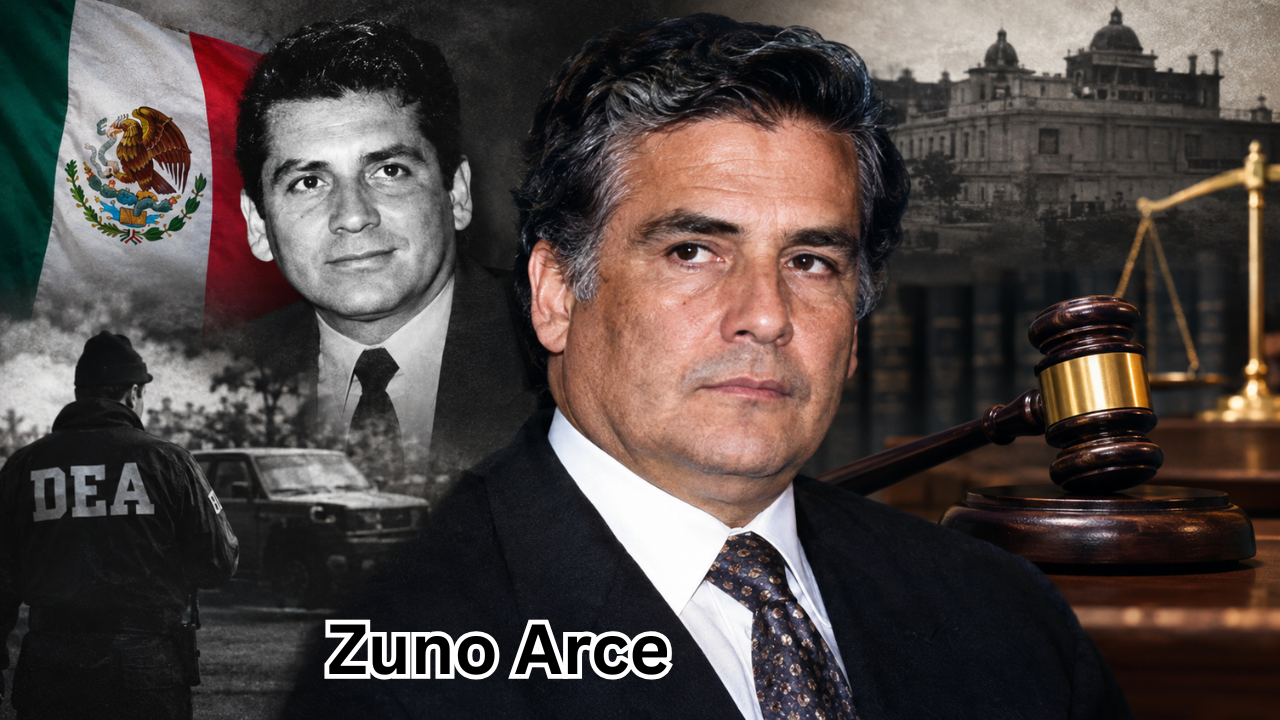
The name Zuno Arce is most commonly associated with Ruben Zuno-Arce, a Mexican businessman whose life became closely connected to one of the most widely discussed criminal cases involving the 1985 kidnapping and murder of U.S. Drug Enforcement Administration (DEA) Special Agent Enrique “Kiki” Camarena.
Zuno-Arce attracted significant public attention not only because of his conviction in the United States, but also because of his family connections to Mexico’s political establishment. He was the brother-in-law of former Mexican President Luis Echeverría, who served as president from 1970 to 1976.
His case involved multiple trials, appeals, questions about evidence and witness testimony, and years of legal proceedings. Understanding the story requires looking beyond headlines and separating what prosecutors alleged from what courts ultimately decided.
This article explores the background of Zuno-Arce, his connection to the Camarena case, his trials and convictions, later appeals, and the historical significance of the case.
Who Was Zuno Arce?
Ruben Zuno-Arce was a Mexican businessman whose name became internationally known after his arrest in the United States in connection with the investigation into the death of DEA agent Enrique Camarena.
According to contemporary reporting, Zuno-Arce was involved in business interests that included ranching, oil, and canning. His family background also placed him within an influential Mexican social and political circle.
His sister, María Esther Zuno Arce, was married to Luis Echeverría, who later became president of Mexico. María Esther served as Mexico’s first lady from 1970 to 1976.
That relationship made Ruben Zuno-Arce a brother-in-law of a former Mexican president, adding a major political dimension to an already high-profile criminal investigation.
However, family connections alone did not determine the outcome of the criminal case. Zuno-Arce was ultimately prosecuted and convicted in U.S. federal court based on charges arising from the Camarena investigation.
The Connection to Enrique Camarena
The story surrounding Zuno-Arce cannot be understood without examining the Camarena case.
Enrique Camarena was a DEA special agent working in Mexico. In February 1985, he was kidnapped in Guadalajara. His pilot, Alfredo Zavala-Avelar, was also abducted.
The killings became a major international law-enforcement case and triggered an extensive investigation into drug-trafficking organizations operating in Mexico.
Court records later described the prosecution of Zuno-Arce as arising from the kidnapping, torture, and murder of Camarena and the related kidnapping of Zavala-Avelar. The legal proceedings eventually focused on whether Zuno-Arce participated in conspiracies connected with the kidnapping and violent crimes.
The case was particularly significant because Camarena was a U.S. federal agent, meaning the investigation had consequences far beyond Mexico.
Why Did Zuno-Arce Become a Major Figure in the Case?
Zuno-Arce’s involvement became especially controversial because of his connections, his Guadalajara property, and evidence presented during the federal proceedings.
Contemporary reporting stated that a house owned by Zuno-Arce in Guadalajara had been sold to a reputed drug trafficker shortly before Camarena’s murder. Authorities alleged that the property had relevance to the crime.
Zuno-Arce consistently denied being a drug trafficker and maintained that he was innocent of the allegations surrounding the murder.
The distinction between allegations and proven facts is important when discussing the Zuno Arce case. Prosecutors presented evidence linking him to criminal activity, while Zuno-Arce and his defense challenged the government’s case.
Ultimately, however, a federal jury convicted him following a second trial.
Zuno Arce’s First Trial
Zuno-Arce’s legal history was complicated by the fact that he was tried more than once.
His first federal trial took place in 1990. He was convicted along with other defendants in a case involving the Camarena kidnapping and murder.
However, the first conviction did not end the legal proceedings.
A federal judge later granted Zuno-Arce a new trial after determining that an improper statement by the prosecutor during closing argument had affected the fairness of the proceedings. The Ninth Circuit subsequently affirmed the decision granting the new trial.
This development became an important part of the Zuno Arce legal story because it demonstrated that the initial conviction was not simply allowed to stand without further judicial review.
The Second Trial and Conviction
Zuno-Arce was retried in federal court in Los Angeles in 1992.
The second prosecution relied on different witnesses from those emphasized during the first trial. Court records indicate that two new witnesses were used by the government to implicate Zuno-Arce in the alleged conspiracy.
On December 21, 1992, a jury found Zuno-Arce guilty of several offenses, including:
- Conspiring to commit violent crimes in aid of a racketeering enterprise
- Committing violent crimes in aid of a racketeering enterprise
- Conspiring to kidnap a federal agent
- Kidnapping a federal agent
The court later imposed two life sentences for the kidnapping counts, along with additional 10-year sentences for the racketeering-related convictions. The sentences were ordered to run concurrently.
The conviction made Ruben Zuno-Arce one of the most prominent defendants connected to the Camarena investigation.
Zuno Arce and the Question of Witness Evidence
One of the most interesting aspects of the case involved witness testimony.
The legal record shows that a witness named Hector Cervantes-Santos had testified during the first trial. Several years later, Cervantes-Santos signed a declaration claiming that he had given false testimony at the urging of the government.
Zuno-Arce’s lawyers later used this issue in attempts to challenge his conviction and sentence.
The district court considered these claims in subsequent proceedings. The Ninth Circuit also reviewed several arguments concerning the government’s handling of evidence and testimony.
The existence of these challenges does not mean the conviction was automatically overturned. Instead, they became part of the extensive post-conviction litigation surrounding the case.
This is one reason the Zuno Arce story remains legally interesting: it includes not only the original prosecution but also years of arguments concerning evidence, constitutional rights, and the conduct of the proceedings.

Appeals and Later Court Proceedings
After his conviction, Zuno-Arce continued to challenge the result through the U.S. federal court system.
In 1995, the U.S. Court of Appeals for the Ninth Circuit considered another appeal involving his conviction. The court’s published decision described the convictions as relating to conspiracy to kidnap, torture, interrogate, and murder DEA Agent Enrique Camarena, along with related offenses.
Zuno-Arce later filed a motion under federal law seeking to vacate, set aside, or correct his sentence.
In a 2000 decision, the Ninth Circuit considered his arguments and affirmed the district court’s denial of his request. The court reviewed issues involving his conviction and post-conviction claims.
A further Ninth Circuit decision in 2003 addressed additional claims, including arguments involving undisclosed evidence and constitutional issues. The court rejected the claims that were before it while addressing the applicable legal standards.
These proceedings demonstrate how long the legal history of Zuno-Arce extended beyond the original trial.
A Quick Timeline of the Zuno Arce Case
| Year | Major Event |
|---|---|
| 1985 | DEA agent Enrique Camarena and pilot Alfredo Zavala-Avelar were kidnapped and murdered in Mexico. |
| 1989 | Ruben Zuno-Arce was arrested and prosecuted in the United States in connection with the investigation. |
| 1990 | Zuno-Arce was convicted in his first federal trial. |
| 1992 | A new trial was held after the earlier conviction was set aside. |
| 1992 | Zuno-Arce was convicted again on kidnapping and racketeering-related charges. |
| 1993 | He received two life sentences, with additional concurrent terms. |
| 1995 | The Ninth Circuit considered another appeal involving his convictions. |
| 2000 | The Ninth Circuit rejected his challenge to the denial of post-conviction relief. |
| 2003 | Another appellate decision addressed additional post-conviction claims. |
| 2012 | Zuno-Arce died while in federal custody in Florida. |
Zuno Arce’s Political and Family Connections
One reason the Zuno Arce name attracted so much attention was the family’s relationship with Mexico’s political establishment.
María Esther Zuno Arce, Ruben’s sister, was married to Luis Echeverría. She served as Mexico’s first lady between 1970 and 1976. Historical records identify her as the daughter of José Guadalupe Zuno Hernández, a former governor of Jalisco.
This background meant that Ruben Zuno-Arce was connected to an influential political family.
Nevertheless, it is important not to confuse political relationships with the legal basis of his conviction. His federal conviction resulted from criminal charges and evidence presented in U.S. court.
The family connection was significant to the public narrative surrounding the case, but it was not itself a criminal offense.
Did Zuno Arce Admit to the Charges?
No. Zuno-Arce maintained his innocence.
Contemporary reporting quoted him denying guilt when he appeared in federal court. His attorneys also challenged the government’s interpretation of his relationship to the events surrounding Camarena’s death.
Despite his denials, a second federal jury convicted him in 1992, and the conviction survived subsequent appeals and post-conviction challenges.
This distinction is important for anyone researching Zuno Arce online. His personal position and the government’s allegations were different, while the eventual judicial outcome was based on the verdict and subsequent court decisions.
What Happened to Zuno Arce?
Ruben Zuno-Arce remained in federal custody after receiving his life sentences.
According to the Los Angeles Times, he died in September 2012 at a federal correctional facility in Florida at the age of 82. The newspaper reported that he had been serving a life sentence related to the Camarena case.
His death brought an end to a legal saga that had lasted for decades.
Even after his conviction, however, the case remained part of broader discussions about the Camarena investigation, U.S.-Mexico law-enforcement relations, organized crime, and the reliability of evidence in major federal prosecutions.
Why Is Zuno Arce Still Discussed Today?
The continued interest in Zuno Arce comes from several overlapping parts of history.
First, the Camarena case itself remains one of the most prominent U.S. drug-enforcement investigations of the 1980s.
Second, Zuno-Arce’s family connection to former Mexican President Luis Echeverría gave the case an unusual political dimension.
Third, his prosecution involved two trials and years of appeals. Questions involving witnesses, evidence, prosecutorial conduct, and post-conviction review created a substantial legal record.
Finally, the case illustrates how complicated high-profile criminal investigations can become when they cross national borders and involve government officials, organized crime allegations, and federal law enforcement.
Frequently Asked Questions About Zuno Arce

Who was Zuno Arce?
Zuno Arce generally refers to Ruben Zuno-Arce, a Mexican businessman who was prosecuted and convicted in the United States in connection with the kidnapping of DEA agent Enrique Camarena. He was also the brother-in-law of former Mexican President Luis Echeverría.
What was Zuno Arce convicted of?
Following his second federal trial in 1992, Zuno-Arce was convicted of conspiracy and kidnapping-related offenses involving a federal agent, as well as racketeering-related violent-crime offenses. He received two life sentences and additional concurrent terms.
Was Zuno Arce tried more than once?
Yes. His first conviction was followed by the granting of a new trial after the court found that an improper prosecutorial statement had affected the first proceedings. He was subsequently retried and convicted in 1992.
Was Zuno Arce related to a Mexican president?
Yes. Zuno-Arce was the brother-in-law of Luis Echeverría, who served as president of Mexico from 1970 to 1976. Zuno-Arce’s sister, María Esther Zuno Arce, was Echeverría’s wife and Mexico’s first lady during his presidency.
When did Zuno Arce die?
Ruben Zuno-Arce died in September 2012 while being held at a federal correctional facility in Florida. He was 82 years old.
Why is the Zuno Arce case historically important?
The case is important because it was connected to the killing of DEA agent Enrique Camarena and involved a lengthy U.S. federal prosecution. It also included multiple trials, appeals, post-conviction litigation, and significant public interest because of Zuno-Arce’s family connections to Mexico’s political elite.
Final Thoughts
The history of Zuno Arce, particularly Ruben Zuno-Arce, is closely tied to one of the most consequential U.S.-Mexico criminal cases of the 1980s. His prosecution became part of the much larger story surrounding DEA agent Enrique Camarena’s kidnapping and murder.
What makes the case especially notable is its complexity. Zuno-Arce faced two federal trials, received a second conviction after the first was overturned, and continued pursuing legal challenges for years afterward.
His family relationship with former Mexican President Luis Echeverría also ensured that his name received substantial attention beyond the courtroom.
For readers researching Zuno Arce today, the most reliable way to understand the story is to distinguish between allegations made during the investigation, arguments raised by the defense, and findings ultimately reached by U.S. courts. That approach provides a clearer picture of a case that remains an important chapter in the history of international drug enforcement and U.S.-Mexico relations.
Also Read : Booflix: What It Is, How It Works, Features, Safety, and What to Know Before Using It











Leave a Reply