

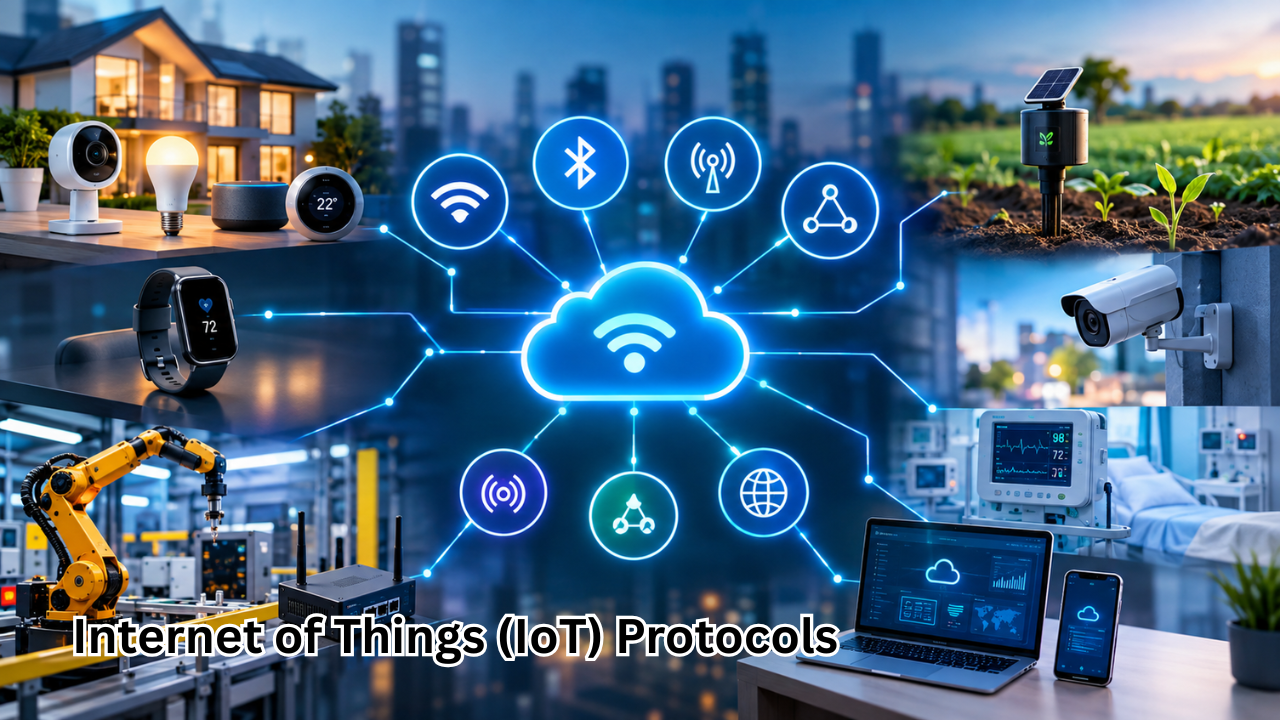
The Internet of Things (IoT) is transforming how people interact with technology, from smart home appliances and wearable devices to industrial machinery and connected healthcare systems. Behind these connected devices are communication standards that allow them to exchange information, respond to commands, and work together efficiently. These standards are known as Internet of Things (IoT) protocols.
IoT protocols determine how devices communicate, how data moves across networks, and how information reaches applications or cloud platforms. Choosing the right protocol can affect a system’s speed, reliability, security, power consumption, and overall cost.
However, not every protocol is suitable for every application. A battery-powered temperature sensor has different communication requirements from a factory robot or a smart security camera. Understanding these differences helps developers, businesses, and technology enthusiasts build better connected systems.
In this guide, we will explore what IoT protocols are, how they work, the most widely used types, their key differences, and how to choose the best option for your project.
What Are Internet of Things (IoT) Protocols?
Internet of Things (IoT) protocols are defined rules and standards that enable connected devices to exchange data with other devices, gateways, servers, and software applications. They establish how information is formatted, transmitted, received, and interpreted.
An IoT ecosystem may include sensors, microcontrollers, wireless networks, cloud services, and user-facing applications. Communication protocols help these components work together, even when they have different capabilities or operate in different environments.
For example, a smart thermostat measures room temperature and sends the reading to a connected system. That system can process the information and instruct the thermostat to adjust the heating or cooling. Communication protocols make this exchange possible.
IoT protocols generally serve different purposes. Some manage communication between devices and applications, while others provide wireless connectivity or reliable data delivery.
Common examples include MQTT, CoAP, HTTP, Bluetooth Low Energy (BLE), Zigbee, Wi-Fi, LoRaWAN, and Thread.
How Do IoT Protocols Work?
IoT communication typically involves several stages, from collecting information to delivering it to the intended destination.
A simple IoT communication process follows these steps:
- Data collection: A sensor or connected device gathers information, such as temperature, movement, humidity, or energy consumption.
- Data preparation: The device formats the information into a structure that the receiving system can understand.
- Network communication: A suitable protocol and communication technology transmit the information.
- Data processing: A gateway, server, or cloud platform receives and processes the data.
- Action or response: The system displays the result, stores the information, triggers an alert, or sends a command back to the device.
Consider a smart agriculture system that monitors soil moisture. A sensor measures the moisture level and communicates the reading through a suitable network. A controller processes the information and may activate an irrigation system when the soil becomes too dry.
The specific protocol depends on the system’s range, power requirements, data volume, network conditions, and security needs.
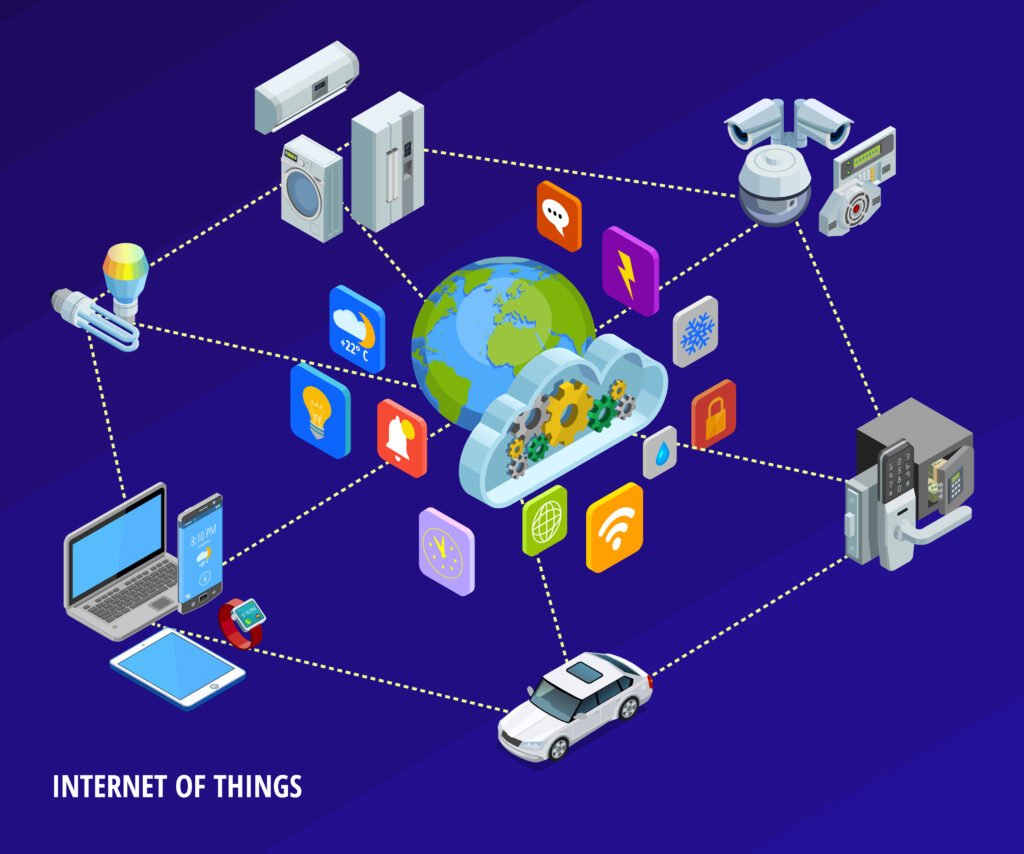
Main Types of Internet of Things (IoT) Protocols
IoT protocols are often grouped according to their roles in a communication system. Understanding these categories makes it easier to compare technologies and identify the right combination for a particular application.
1. MQTT (Message Queuing Telemetry Transport)
MQTT is a lightweight messaging protocol widely used in IoT systems that need efficient communication over networks with limited bandwidth or inconsistent connectivity.
It follows a publish-subscribe model. Devices publish messages to a broker, and other devices or applications subscribe to the topics they want to receive. This approach allows components to exchange information without maintaining a direct connection to every other device.
MQTT is commonly used in industrial monitoring, smart homes, remote equipment management, and sensor networks.
Key advantages of MQTT include:
- Low communication overhead.
- Efficient messaging for resource-constrained devices.
- Support for different quality-of-service levels.
- Flexible communication between multiple devices and applications.
MQTT typically runs over TCP and can use TLS to protect connections. It is a strong option when small, frequent messages need to move reliably between connected systems.
2. CoAP (Constrained Application Protocol)
CoAP is designed for constrained devices and networks where memory, processing power, bandwidth, or energy may be limited.
It uses a request-response approach similar in concept to HTTP, but its design is more suitable for small devices. CoAP commonly operates over UDP, although other transport arrangements are possible.
This protocol is useful for smart lighting, environmental sensors, building automation, and device-to-device communication.
Its advantages include compact messages, support for resource discovery, and efficient communication in constrained environments. CoAP can also support multicast communication, which is useful when a message needs to reach multiple devices.
For security, CoAP deployments can use Datagram Transport Layer Security (DTLS) or other supported security mechanisms, depending on the implementation.
3. HTTP and HTTPS
HTTP is one of the most familiar communication protocols on the internet. It allows clients to request information from servers and submit data to web services.
IoT devices can use HTTP APIs to send sensor readings, retrieve configuration settings, or interact with cloud platforms. HTTPS adds TLS protection to help secure information exchanged between clients and servers.
HTTP is particularly useful when an IoT device needs to integrate with an existing web application or cloud service.
However, its request-response model and message overhead may make it less efficient than lightweight alternatives for devices that send frequent, tiny messages over limited networks.
HTTP and HTTPS are often suitable for gateways, powerful connected devices, dashboards, and cloud integrations.
4. Bluetooth Low Energy (BLE)
Bluetooth Low Energy is a wireless communication technology designed to transfer small amounts of data while consuming relatively little power.
BLE is widely used in fitness trackers, smartwatches, health-monitoring accessories, proximity sensors, and smart home devices. It can communicate directly with nearby smartphones, tablets, and compatible gateways.
One of its main benefits is its suitability for battery-powered devices. Many BLE applications can operate for extended periods without frequent battery replacement when properly designed.
BLE generally works over short distances, and actual range depends on factors such as radio conditions, device design, transmit power, and obstacles.
It is a practical choice for applications that need local wireless connectivity rather than direct long-distance communication.
5. Zigbee
Zigbee is a low-power wireless networking technology commonly associated with smart home automation, lighting, and sensor networks.
It supports mesh networking, allowing compatible devices to forward messages through other network nodes. This can help extend coverage beyond the range of a single direct connection.
Zigbee is often used for smart bulbs, switches, motion detectors, door sensors, and energy-monitoring devices.
Its low energy requirements make it suitable for battery-powered sensors, while mesh networking can improve coverage in buildings with many connected devices.
However, interoperability depends on device profiles, supported application features, and compatibility between products. Buyers should check whether devices work with their chosen hub or controller.
6. Wi-Fi
Wi-Fi provides wireless network connectivity and is widely available in homes, offices, and commercial buildings.
It is a practical option for IoT devices that need relatively high data rates or already have access to a local wireless network. Smart cameras, connected appliances, displays, and some home automation products commonly use Wi-Fi.
Wi-Fi can carry large amounts of data and connect devices to local networks or the internet without requiring a separate low-power mesh network.
The main trade-off is energy consumption. Depending on the device and operating mode, Wi-Fi may use more power than technologies designed specifically for small, infrequent sensor messages.
It is therefore often better suited to mains-powered devices or battery-powered products with carefully managed communication schedules.
7. LoRaWAN
LoRaWAN is a low-power wide-area networking protocol designed to connect devices across long distances while keeping energy consumption low.
It is useful for applications that transmit small amounts of data occasionally rather than continuously streaming information. Examples include agricultural sensors, water meters, environmental monitoring equipment, and smart city infrastructure.
LoRaWAN can support deployments across large outdoor areas, depending on antenna placement, terrain, local radio conditions, and network configuration.
Its main strengths include long-range communication and the potential for long battery life. However, its relatively low data rates make it unsuitable for applications such as high-resolution video streaming.
Devices generally communicate through gateways that forward messages to a network server.
8. Thread
Thread is a low-power, IPv6-based wireless mesh networking technology designed for connected devices.
It is especially relevant to smart home applications, where sensors, switches, locks, and other devices need reliable local communication. Thread networks can use multiple nodes to forward messages, helping devices communicate throughout a building.
Thread is also an important networking foundation for many Matter-enabled smart home products. However, Thread and Matter are not the same thing: Thread provides network connectivity, while Matter defines an application-layer framework for compatible smart home devices.
Thread is useful for developers who want low-power mesh networking with IP-based communication and support for modern smart home ecosystems.
Comparison of Popular IoT Protocols
Different IoT protocols serve different purposes. The following table summarizes their typical characteristics and common applications.
| Protocol or technology | Main strength | Typical range or connectivity | Common use cases |
|---|---|---|---|
| MQTT | Lightweight messaging | Network or internet via a broker | Industrial monitoring, cloud telemetry |
| CoAP | Efficient communication for constrained devices | IP-based networks | Sensors, building automation |
| HTTP/HTTPS | Broad web compatibility | Local network or internet | Cloud APIs, connected appliances |
| Bluetooth Low Energy | Low power consumption | Short-range wireless | Wearables, nearby sensors |
| Zigbee | Low-power mesh networking | Local wireless mesh | Smart lighting, home automation |
| Wi-Fi | High data throughput | Local wireless network | Cameras, smart appliances |
| LoRaWAN | Long-range, low-power communication | Wide-area wireless network | Agriculture, meters, smart cities |
| Thread | IPv6-based mesh networking | Local wireless mesh | Smart home sensors and controls |
These technologies are not direct substitutes in every situation. MQTT and HTTP primarily describe application-level communication, while BLE, Zigbee, Wi-Fi, LoRaWAN, and Thread address wireless connectivity or networking. CoAP is an application-layer protocol designed for constrained environments.
A complete IoT solution may combine several of them. For example, a sensor could use Thread for local connectivity while an application uses an IP-based protocol to exchange data with another service.
Why Are IoT Protocols Important?
Choosing the right communication protocol affects more than whether two devices can exchange information. It influences how well the entire system performs as it grows.
Efficient Data Transmission
Lightweight protocols reduce unnecessary communication overhead. This is particularly important when devices send small readings at regular intervals or operate on limited network connections.
Efficient transmission can also reduce network congestion and improve responsiveness.
Lower Power Consumption
Many IoT devices rely on batteries and may be installed in locations where frequent maintenance is inconvenient.
Protocols and network technologies designed for low-power operation can help devices remain active for longer periods. Actual battery life still depends on radio activity, sensor usage, hardware design, and how often information is transmitted.
Better Scalability
An IoT deployment may start with a handful of sensors and eventually expand to thousands of devices.
Appropriate messaging patterns, network architecture, and device management practices make it easier to handle additional devices without creating unnecessary communication bottlenecks.
Improved Security
IoT devices can collect sensitive information or control physical equipment. Secure communication is therefore essential.
Depending on the protocol and implementation, security measures may include encryption, authentication, access controls, secure key management, and regular firmware updates.
No protocol automatically makes an entire IoT deployment secure. Security also depends on configuration, device capabilities, and the wider system architecture.
Greater Interoperability
IoT ecosystems often include equipment from different manufacturers. Standardized protocols and compatible application frameworks help these devices communicate more consistently.
Nevertheless, sharing a protocol does not guarantee complete compatibility. Devices may still use different data formats, features, security settings, or application-specific implementations.
How to Choose the Right IoT Protocol
The best protocol depends on the requirements of the application rather than on popularity alone.
Before selecting a technology, evaluate the following factors.
- Range: Determine whether devices need to communicate within a room, throughout a building, or across a large outdoor area.
- Power consumption: Identify whether the device is battery-powered or connected to a continuous power source.
- Data volume: Consider whether the application sends occasional sensor readings or requires high-bandwidth communication.
- Latency: Decide how quickly a device must receive information or respond to a command.
- Network reliability: Assess whether the system must tolerate weak signals, intermittent connectivity, or changing network conditions.
- Security: Check the available encryption, authentication, authorization, and device-management options.
- Cost: Consider hardware prices, gateways, infrastructure, connectivity fees, and ongoing maintenance.
- Compatibility: Confirm that the protocol works with your existing devices, cloud platform, and application software.
For example, a wearable fitness tracker may benefit from BLE because it communicates with a nearby smartphone and needs to conserve battery power. An agricultural sensor distributed across a large field may be better suited to LoRaWAN.
A smart camera that sends high-resolution video will generally need a higher-bandwidth connection, such as Wi-Fi or Ethernet, rather than a low-data-rate sensor network.
For an industrial system that sends frequent sensor readings to a central application, MQTT may be a good messaging option, provided the network and security requirements are addressed.
The most effective design often combines multiple protocols to meet different needs across the same IoT ecosystem.
Common Challenges in IoT Protocol Implementation
Although IoT protocols make connected systems possible, implementation can involve several challenges.
Interoperability issues: Devices from different manufacturers may support different profiles, message formats, or optional features. Testing compatibility before deployment helps prevent integration problems.
Security vulnerabilities: Weak passwords, outdated firmware, exposed services, and poor access controls can undermine an otherwise suitable communication protocol. Security should be considered throughout the device lifecycle.
Limited device resources: Some sensors have very little memory, processing power, or battery capacity. Developers must balance communication frequency, reliability, and energy usage.
Network interference: Wireless communication can be affected by physical obstacles, competing radio signals, and environmental conditions. Site surveys and careful placement can improve reliability.
Scaling difficulties: A design that works with ten devices may struggle with thousands. Capacity planning, monitoring, device provisioning, and network management should be considered early.
Testing with realistic workloads and deployment conditions can help identify these issues before they affect users.

The Future of Internet of Things (IoT) Protocols
IoT communication continues to evolve as connected devices become more common in homes, factories, healthcare, agriculture, transportation, and public infrastructure.
Several developments are shaping this landscape.
Greater interoperability: Technologies such as Matter are helping compatible smart home devices work across supported ecosystems, reducing some of the fragmentation that has historically affected consumers.
Edge computing: More processing can take place near the device rather than sending every reading to a remote cloud platform. This can reduce latency and network traffic when applications are designed appropriately.
Improved energy efficiency: Advances in low-power wireless technologies and device design are helping support sensors that need to operate for long periods with minimal maintenance.
Stronger security practices: Secure onboarding, device identity, encrypted communication, and ongoing software updates are becoming increasingly important as deployments expand.
Integration with artificial intelligence: IoT data is increasingly used by analytics and AI systems to detect unusual patterns, predict equipment failures, and improve automated decision-making.
These trends do not point toward a single protocol replacing all others. Different applications will continue to require different combinations of communication technologies, depending on their performance, power, range, and security requirements.
Frequently Asked Questions (FAQs)
1. What are Internet of Things (IoT) protocols?
Internet of Things (IoT) protocols are communication rules and standards that allow connected devices to exchange data. They define how messages are transmitted and interpreted across devices, networks, gateways, and applications. Common examples include MQTT, CoAP, HTTP, Bluetooth Low Energy, Zigbee, and LoRaWAN.
2. Which IoT protocol is most commonly used?
There is no single protocol that is best or most common for every IoT application. MQTT is widely used for messaging and telemetry, HTTP is popular for web and cloud integration, BLE is common in wearables, and Wi-Fi is widely used in connected home devices. The right choice depends on the application’s requirements.
3. What is the difference between MQTT and HTTP?
MQTT uses a publish-subscribe messaging model in which devices exchange messages through a broker. HTTP typically uses a request-response model in which a client communicates with a server. MQTT is often suitable for frequent, lightweight telemetry, while HTTP is useful for web APIs and cloud services. Both can be secured when configured appropriately.
4. Which IoT protocol is best for low-power devices?
Bluetooth Low Energy, Zigbee, Thread, and LoRaWAN are common options for low-power applications, but they serve different needs. BLE is suitable for nearby devices, Zigbee and Thread support local mesh networking, and LoRaWAN is designed for long-range, low-data-rate communication.
5. Are IoT protocols secure?
IoT protocols can support secure communication, but overall security depends on the specific protocol, implementation, and configuration. Encryption, strong authentication, appropriate access controls, secure device provisioning, and regular firmware updates are important safeguards.
6. Can an IoT system use multiple protocols?
Yes. Many IoT systems combine multiple protocols because different devices have different communication requirements. For example, a sensor may use BLE or Zigbee to communicate locally, while a gateway uses MQTT or HTTPS to send information to a cloud platform.
Final Thoughts
Internet of Things (IoT) protocols are the foundation of communication in connected systems. They enable devices to collect information, exchange messages, respond to commands, and integrate with applications across many industries.
From MQTT and CoAP to BLE, Zigbee, Wi-Fi, LoRaWAN, and Thread, each technology offers different advantages. Some prioritize low power consumption, others support long-distance communication, and some provide efficient messaging or broad compatibility with internet services.
The key is to match the protocol to the project’s actual needs. Consider range, power usage, data volume, latency, security, scalability, and compatibility before making a decision.
With the right combination of protocols and a well-designed architecture, developers and businesses can build IoT solutions that are more reliable, efficient, secure, and easier to maintain as technology and requirements evolve.
Also Read : GitLab vs GitHub: Key Differences, Features, Pricing, and Which One to Choose










Leave a Reply