

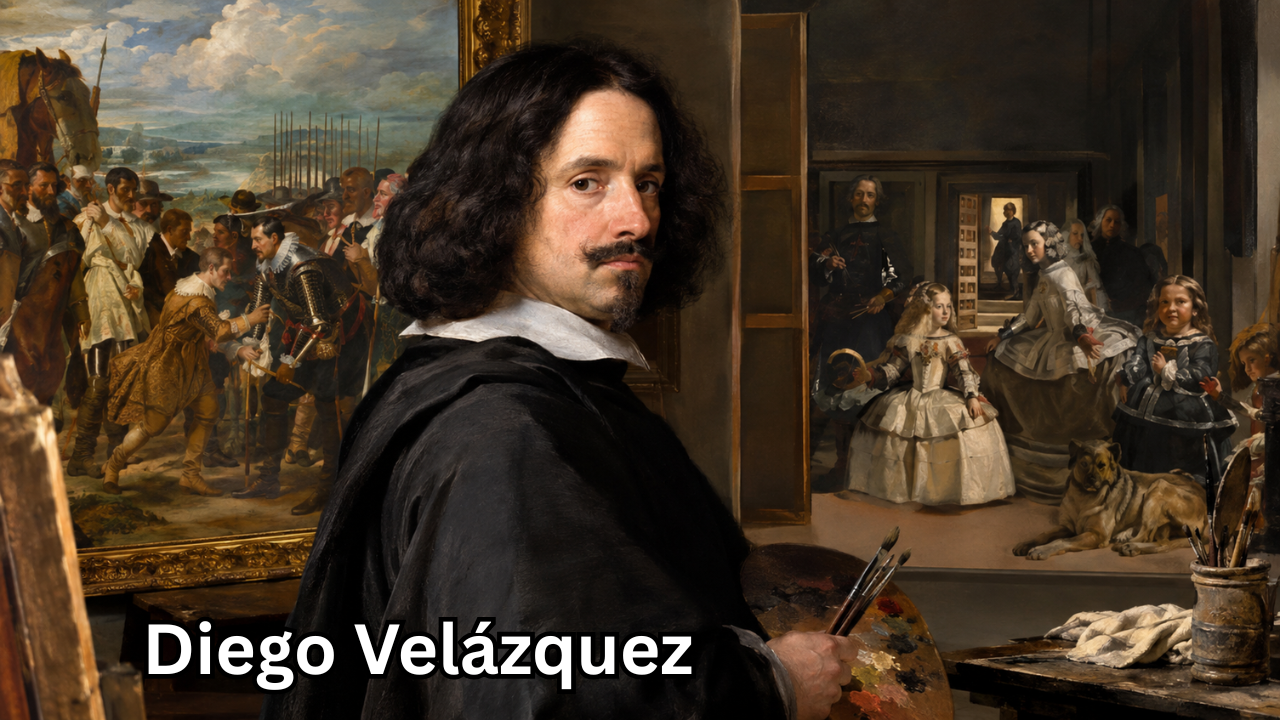
Diego Velázquez is widely regarded as one of the greatest painters of the Spanish Golden Age and one of the most influential artists in the history of Western painting. Born in Seville in 1599 and active mainly in Madrid, he became the leading painter at the court of King Philip IV of Spain. His portraits, historical scenes, religious works, and everyday subjects are admired for their realism, subtle lighting, remarkable brushwork, and psychological depth.
What makes Diego Velázquez particularly fascinating is the way his style changed throughout his career. His early paintings show a strong interest in ordinary people, kitchens, taverns, and carefully observed objects. Later, his work became more sophisticated and atmospheric, with loose brushstrokes that could create an extraordinary sense of movement and life.
Among his many achievements, Las Meninas remains his most famous painting. Created in 1656, the work is celebrated not simply as a portrait of the Spanish royal family but as a complex exploration of perception, representation, and the role of the artist. Today, Velázquez’s paintings remain central to the collection of the Museo del Prado in Madrid and continue to influence artists, historians, and art lovers around the world.
Who Was Diego Velázquez?
Diego Rodríguez de Silva y Velázquez was a Spanish painter who lived from 1599 to 1660. He was born in Seville, where he received his early artistic training before eventually moving to Madrid.
The Museo del Prado notes that Velázquez adopted his mother’s surname, following a common Andalusian naming practice. He worked professionally in Seville until the age of 24, after which he moved with his family to Madrid and entered royal service.
His career changed dramatically after his arrival at the Spanish court. Velázquez eventually became the principal painter to King Philip IV, giving him access to members of the royal family, aristocrats, diplomats, and the extensive art collections owned by the Spanish monarchy.
This position provided him with both status and opportunity. He could study the work of earlier masters while developing an increasingly personal approach to portraiture and painting.
Early Life and Artistic Training
Velázquez grew up in Seville, a major cultural and commercial center during the early seventeenth century. The city had a strong artistic tradition, and the young painter received training under Francisco Pacheco.
Pacheco was more than Velázquez’s teacher. He later became his father-in-law, creating an important personal and professional connection. According to the Museo del Prado, Pacheco left valuable information about Velázquez’s apprenticeship, early career, and first journey to Italy in a treatise completed in 1638 and published in 1649.
During his early years, Velázquez showed a particular interest in realistic scenes of everyday life. He painted people eating and drinking, kitchen interiors, religious subjects, and ordinary objects with unusual attention to texture and physical detail.
This early period is important because it established qualities that remained central to his later work: close observation, naturalistic figures, controlled lighting, and an ability to make ordinary subjects visually compelling.
Diego Velázquez at the Spanish Court
The most important turning point in Velázquez’s career came when he moved to Madrid at the age of 24 and entered the service of King Philip IV.
The royal court gave him opportunities that would have been difficult to obtain elsewhere. He became responsible for portraits of the king and members of the royal family, while also painting other subjects for the court.
Velázquez did not simply reproduce appearances. His royal portraits often communicate personality, authority, uncertainty, or dignity through posture, facial expression, clothing, and the surrounding space.
His position also allowed him to study paintings belonging to the royal collection. The Prado’s educational material explains that his role at court gave him access to the works collected by Philip IV in his palaces.
This exposure played a significant role in the development of his mature style.
The Evolution of Velázquez’s Painting Style
One of the most interesting aspects of Diego Velázquez is how dramatically his technique developed.
His early paintings tend to have clearly defined forms and strong contrasts between light and dark. As he matured, however, his brushwork became increasingly economical and expressive.
Instead of carefully outlining every object, he could suggest form with a few strategically placed strokes. From close range, some passages may appear rough or incomplete. From a suitable distance, however, those strokes combine into convincing figures, fabrics, surfaces, and spaces.
The Museo del Prado describes this later approach as a transformation of Velázquez’s detailed naturalism into a more fleeting vision of figures and scenes. The museum also notes that his later brushwork anticipated aspects of nineteenth-century painting and influenced artists such as Édouard Manet.
This helps explain why Velázquez feels surprisingly modern despite having worked in the seventeenth century.
Famous Paintings by Diego Velázquez
Velázquez produced works across several genres, but a number of paintings have become especially important in the history of art.
| Painting | Approx. Date | Why It Matters |
|---|---|---|
| Adoration of the Magi | 1619 | An important early religious painting |
| The Triumph of Bacchus | 1628–1629 | Combines mythology with realistic figures |
| The Surrender of Breda | c. 1635 | A celebrated historical painting |
| Las Meninas | 1656 | His most famous and complex masterpiece |
| The Spinners / The Fable of Arachne | c. 1655–1660 | Demonstrates his mature style and interest in art and mythology |
The Museo del Prado dates Adoration of the Magi to 1619 and The Triumph of Bacchus to 1628–1629. The Surrender of Breda is generally dated to around 1635.
Together, these paintings demonstrate the remarkable range of Velázquez’s career.
Why Las Meninas Is So Important
No discussion of Diego Velázquez is complete without Las Meninas.
Painted in 1656, the enormous oil painting measures approximately 320.3 by 279.1 centimeters. It depicts the young Infanta Margarita surrounded by attendants, while Velázquez himself appears inside the composition with a palette and brush.
At first glance, the scene may appear to be a royal portrait. A closer look reveals something much more complicated.
A mirror on the back wall appears to reflect King Philip IV and Queen Mariana of Austria. The viewer is therefore encouraged to consider where the monarchs are standing and what exactly the people in the room are looking at.
This creates an unusual relationship between the painting, the artist, the royal family, and the viewer.
The Prado describes Las Meninas as a work containing a dense network of meanings. It can be interpreted as a reflection on royal identity, artistic status, perception, and the boundary between painting and reality.
That ambiguity is one reason the painting has generated so much discussion for centuries.
The Meaning Behind Las Meninas
The title itself has an interesting history.
The painting was not always known as Las Meninas. Earlier inventories used different titles, including descriptions referring to the emperor’s daughter, her ladies, and other figures. According to the Prado, the title Las Meninas first appeared in a Museo del Prado catalogue in 1843 and eventually became the standard name.
The word “meninas” refers to young attendants serving members of the Spanish royal family.
Velázquez’s self-portrait within the composition is equally significant. By placing himself among the royal household, he draws attention to the intellectual and social status of painting.
The work therefore operates on several levels at once:
- It is a royal portrait.
- It is a scene from court life.
- It is a study of perspective and perception.
- It draws attention to the painter himself.
- It explores the relationship between art and reality.
- It raises questions about who is looking at whom.
That complexity gives Las Meninas an unusual ability to reward repeated viewing.
Velázquez’s Approach to Portraiture
Portraiture was central to Velázquez’s career, especially after he joined the Spanish court.
His portraits are notable for their restraint. Rather than exaggerating expressions, he often allowed small details to communicate character.
The position of a person’s body, the direction of the eyes, the treatment of clothing, and the surrounding darkness can all contribute to the impression of personality.
His portraits of Philip IV are particularly important because Velázquez painted the monarch repeatedly over many years. This allowed him to document the king’s changing appearance while maintaining a consistent sense of royal identity.
Rather than relying on excessive decoration, Velázquez often used controlled compositions and subtle variations in color and light.
Velázquez and Realism
Realism is one of the words most frequently associated with Diego Velázquez, but his realism was more sophisticated than simply copying what he saw.
He understood that the human eye does not experience every detail equally. Some objects appear sharply defined while others become softer with distance.
Velázquez used this principle to create convincing depth.
His mature paintings can therefore look remarkably spontaneous. A face might be defined with only a few strokes, while a complicated fabric may be suggested through changes in tone rather than painstakingly rendered threads.
This technique helped make his paintings feel alive rather than overly polished.
His Influence on Later Artists
Velázquez’s influence extended far beyond seventeenth-century Spain.
His ability to suggest rather than over-explain became particularly important to later painters. Artists in the nineteenth century recognized the freedom and modernity of his brushwork.
Édouard Manet was among the artists strongly influenced by Velázquez. The Prado notes that Velázquez’s later works anticipated aspects of Manet and other nineteenth-century artists.
His influence also continued into the twentieth century. Las Meninas became a subject for reinterpretation by artists including Pablo Picasso, who created an extensive series based on the famous composition.
This lasting influence shows that Velázquez was not simply an important Spanish painter. His ideas about seeing, representation, and artistic technique became part of the broader development of modern art.
Where to See Velázquez’s Art Today
The Museo del Prado in Madrid is one of the most important places for studying Diego Velázquez.
A large portion of his work was originally created for the Spanish royal collection and later entered the Prado. The museum describes Velázquez’s work as occupying a particularly important position within its collection.
Visitors can see major works including Las Meninas, The Spinners, and The Surrender of Breda.
The Prado also provides digital resources that allow people around the world to explore parts of its collection online. Its virtual collection includes high-resolution digitized works and a 360-degree museum experience.
For anyone interested in Spanish art, a study of Velázquez at the Prado provides an excellent introduction to the artistic culture of seventeenth-century Spain.
Diego Velázquez’s Final Years
Velázquez remained connected to the Spanish court until the end of his life.
In his later years, his painting became increasingly confident and unconventional. The Spinners and Las Meninas are particularly important examples of this mature period. The Prado describes these works as innovative and difficult to classify within conventional categories.
In 1660, Velázquez accompanied the royal court to the French border for the marriage of Infanta María Teresa to Louis XIV. After returning to Madrid, he became ill.
He died on August 6, 1660, at the age of 61. He had been awarded the Order of Santiago the previous year, a sign of the high status he had achieved at the Spanish court.
Why Diego Velázquez Still Matters
More than three centuries after his death, Velázquez remains relevant because his paintings raise questions that extend beyond their historical setting.
He showed that a portrait could communicate more than physical appearance. He demonstrated that a historical scene could contain human complexity. Most importantly, he showed that a painting could make viewers question their own position within an image.
His technical skill is impressive, but his greatest achievement may be his ability to make paintings feel open-ended.
A viewer can look at Las Meninas repeatedly and still notice new relationships, gestures, reflections, and visual clues.
That quality helps explain why Velázquez continues to attract scholars, students, artists, and casual museum visitors alike.
Frequently Asked Questions About Diego Velázquez

Who was Diego Velázquez?
Diego Velázquez was a Spanish painter of the seventeenth century, born in Seville in 1599 and best known for his royal portraits and masterpieces such as Las Meninas. He served King Philip IV and remained connected to the Spanish court for most of his career.
What is Diego Velázquez’s most famous painting?
His most famous painting is generally considered to be Las Meninas, completed in 1656. The work depicts the Infanta Margarita, members of her household, Velázquez himself, and a reflection of the king and queen.
What style of art did Velázquez use?
Velázquez is associated with naturalism and realism, but his mature style became increasingly loose and atmospheric. He used economical brushwork, subtle lighting, and carefully observed details to create convincing figures and spaces.
Where was Diego Velázquez born?
Velázquez was born in Seville, Spain, in 1599. He trained and worked there during his early career before moving to Madrid at the age of 24.
Why is Las Meninas considered a masterpiece?
Las Meninas is admired because it combines portraiture with complex ideas about perspective, perception, royal identity, and the role of the artist. The mirror and the placement of Velázquez within the scene make viewers question what is happening outside and inside the painted space.
When did Diego Velázquez die?
Velázquez died in Madrid on August 6, 1660, shortly after returning from a royal journey connected with the marriage of Infanta María Teresa and Louis XIV.
Final Thoughts
Diego Velázquez left behind a body of work that continues to define how we understand Spanish Baroque painting. His career moved from the realistic scenes of his youth to sophisticated royal portraits and highly experimental masterpieces.
Las Meninas stands at the center of that achievement, but it should not overshadow the extraordinary variety of his other paintings. From The Triumph of Bacchus and The Surrender of Breda to The Spinners, Velázquez repeatedly demonstrated his ability to combine observation, technique, atmosphere, and intellectual depth.
His influence on later painters confirms the lasting importance of his approach. Even today, his paintings feel remarkably fresh because they do not simply tell viewers what to see. They invite us to look, question, and discover.
For anyone interested in art history, Spanish painting, or the development of modern visual language, studying Diego Velázquez offers an opportunity to see how one seventeenth-century artist transformed the possibilities of painting.
Also Read : Zuno Arce: The Life, Case, and Historical Background of Ruben Zuno-Arce











Leave a Reply