

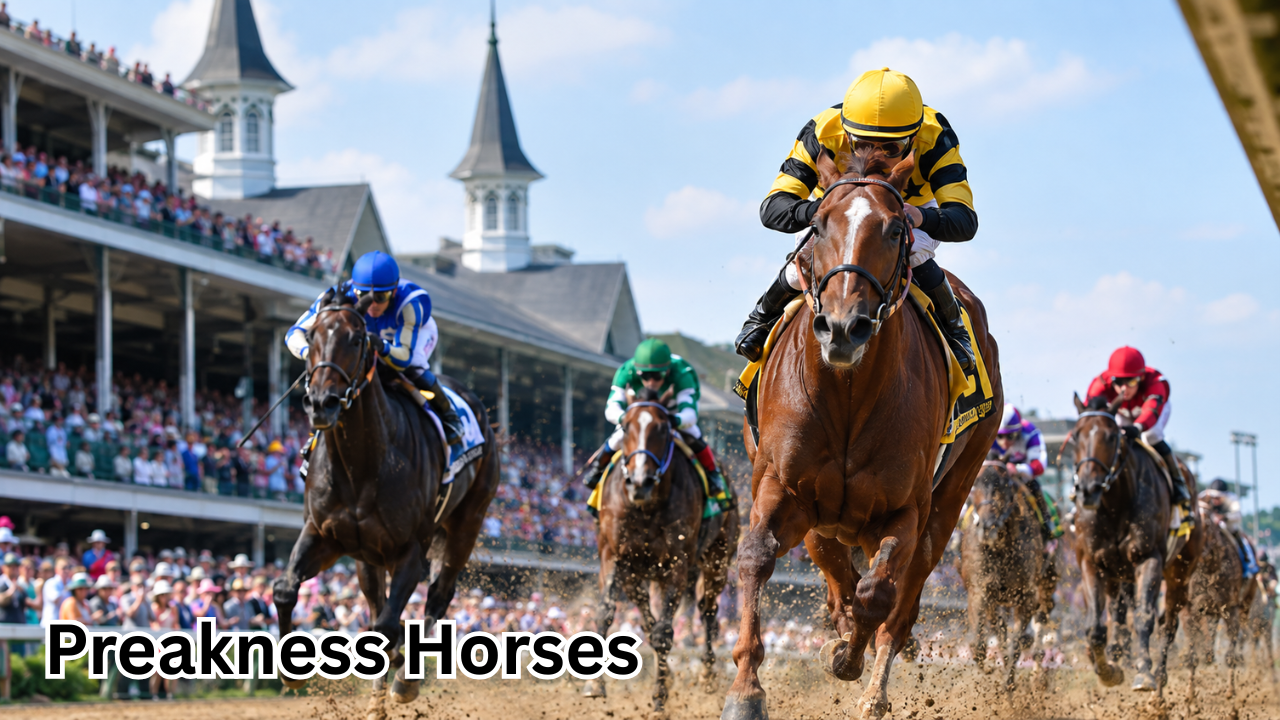
The Preakness horses are at the center of one of the most important events in American Thoroughbred racing. Held each spring, the Preakness Stakes brings together talented three-year-old horses for the second leg of the Triple Crown, following the Kentucky Derby and preceding the Belmont Stakes.
For racing fans, the appeal goes beyond simply watching a horse cross the finish line first. Each Preakness horse arrives with a different racing record, training background, pedigree, running style, and level of experience. Some enter after competing in the Kentucky Derby, while others take a different route and target the Preakness specifically.
The race has also produced some of the most memorable horses in racing history, including Secretariat, American Pharoah, Seattle Slew, Affirmed, and many others.
As of 2026, the Preakness has reached its 151st running, with Napoleon Solo winning the 2026 Preakness Stakes at Laurel Park. The 2026 race was particularly notable because Laurel Park temporarily hosted the event while Pimlico Race Course underwent redevelopment.
Whether you are new to horse racing or regularly follow the Triple Crown, understanding the horses competing in the Preakness makes the race much more interesting.
What Are Preakness Horses?
The term “Preakness horses” generally refers to the Thoroughbred racehorses that compete, or are expected to compete, in the Preakness Stakes.
The Preakness is traditionally a race for three-year-old Thoroughbreds. It is one of the three races that make up the American Triple Crown, along with the Kentucky Derby and Belmont Stakes. The Preakness has been part of American racing history since 1873.
Unlike an ordinary race, the Preakness attracts horses that have already built reputations through important races during their two- and three-year-old seasons.
A typical Preakness field can include:
- Horses coming directly from the Kentucky Derby
- Horses that skipped the Kentucky Derby
- Horses that qualified through important preparatory races
- Horses with strong regional racing records
- Long-shot competitors looking to create an upset
- Highly regarded horses with Grade 1 experience
This mixture is one reason the Preakness can produce unexpected results.
How Preakness Horses Reach the Starting Gate
Getting into the Preakness is not simply a matter of entering a horse and showing up on race day. Owners and trainers carefully plan a horse’s three-year-old campaign around major qualifying races and preparation opportunities.
The Kentucky Derby is an obvious pathway because many Derby competitors are also potential Preakness starters. However, the Preakness field is not limited to horses that ran in Louisville two weeks earlier.
Some horses are specifically prepared for the Preakness after competing elsewhere.
That strategy can be important because the Triple Crown schedule demands that young horses recover, travel, and compete at a high level within a short period.
A trainer may therefore consider:
- Recent race results
- Distance experience
- Recovery time
- Track conditions
- Previous performance against high-quality competition
- Pedigree and stamina
- Training workouts
- Jockey availability
- Post position
The goal is to have a horse arrive at the Preakness physically prepared and capable of handling the demands of the race.
What Makes a Good Preakness Horse?
There is no single characteristic that guarantees success. The Preakness brings together horses with different running styles and racing histories.
However, several factors are particularly important when evaluating a Preakness horse.
Speed and Stamina
The Preakness requires more than raw speed. A horse must be able to maintain a strong pace while handling the demands of a major stakes race.
A horse that starts quickly but struggles late may face difficulties against competitors with greater stamina.
Recent Form
Recent races can provide useful information about a horse’s current condition.
A horse that has consistently performed well in major races may attract considerable attention. At the same time, racing history shows that a horse does not always need to enter the Preakness with an obvious winning record.
The 2026 Preakness illustrated that point. Napoleon Solo entered after finishing fifth in both the Fountain of Youth Stakes and Wood Memorial, yet won the Preakness at 10-1 odds.
Running Style
Horses can approach a race in different ways.
Some prefer to run near the front, while others settle farther back and make a late move. Understanding a horse’s running style can help explain how it might respond to the pace and positioning of a particular race.
Experience
Experience against strong competition can be valuable, especially in a major Grade 1 event.
However, an inexperienced horse can sometimes surprise more established competitors. For that reason, looking only at the number of previous starts does not provide the complete picture.
2026 Preakness Horses: A Look Back at the Field
The 151st Preakness Stakes was held on May 16, 2026, at Laurel Park. The temporary move from Pimlico was caused by redevelopment work at the historic Baltimore track. The Preakness is scheduled to return to Pimlico in 2027.
The 2026 field included horses with very different racing backgrounds.
| Horse | Jockey | Trainer | Notable Detail |
|---|---|---|---|
| Napoleon Solo | Paco Lopez | Chad Summers | Won the 151st Preakness |
| Iron Honor | Flavien Prat | Chad Brown | Entered after major stakes experience |
| Chip Honcho | Jose Ortiz Jr. | Steve Asmussen | Had experience in major 2026 prep races |
| Ocelli | Tyler Gaffalione | Whitworth Beckman | Came from the Kentucky Derby |
| Incredibolt | Jaime Torres | Riley Mott | Finished sixth in the Kentucky Derby |
| Bull by the Horns | Micah Husbands | Saffie Joseph Jr. | Won the Rushaway Stakes |
| The Hell We Did | Luis Saez | Todd Fincher | Entered with two wins and two seconds in four starts |
| Taj Mahal | Sheldon Russell | Brittney Russell | Unbeaten in three starts at Laurel |
The official Preakness records show that Napoleon Solo won the race after making his move entering the homestretch and pulling away from Iron Honor.
Taj Mahal was another interesting horse in the field. He entered the race unbeaten in three starts, all at Laurel, and had won the Tesio Stakes by 8¼ lengths. That made him the only starter with previous racing experience over the 2026 Preakness track.
Ocelli also attracted attention because he had finished third in the Kentucky Derby despite entering that race at odds of 70-1.
These examples demonstrate why the Preakness field can be difficult to assess based solely on previous expectations.
Famous Preakness Horses in History
The history of the Preakness is filled with horses that became legendary beyond the race itself.
Secretariat
Secretariat remains one of the most famous names in American horse racing.
In 1973, he won the Preakness as part of his historic Triple Crown campaign. He later won the Belmont Stakes by an extraordinary 31 lengths, completing one of the most celebrated Triple Crown performances in racing history.
Seattle Slew
Seattle Slew made history in 1977 by becoming the only Thoroughbred to complete the Triple Crown while undefeated.
His Preakness victory was one part of an unbeaten Triple Crown season that established him among the most recognizable horses in racing history.
Affirmed
Affirmed won the Triple Crown in 1978.
His rivalry with Alydar became one of the defining stories of the era. The Preakness was particularly close, with Affirmed defeating Alydar by a neck before the two horses met again in the Belmont Stakes.
American Pharoah
American Pharoah ended a 37-year Triple Crown drought in 2015.
He won the Kentucky Derby, Preakness, and Belmont Stakes before later becoming the first Triple Crown winner to capture the Breeders’ Cup Classic. His Preakness victory came by seven lengths in difficult, rainy conditions.
Justify
Three years later, Justify became the 13th horse to win the American Triple Crown, following victories in the Kentucky Derby, Preakness, and Belmont Stakes.
These horses demonstrate how a Preakness appearance can become part of a much larger racing legacy.
Why Some Kentucky Derby Horses Skip the Preakness
It is common for fans to expect every Kentucky Derby horse to appear in the Preakness, but that is not always the case.
The two-week gap between the races is demanding, particularly for three-year-old Thoroughbreds. Trainers and owners must consider the individual horse rather than simply following the Triple Crown schedule.
A horse may skip the Preakness because of:
- Recovery needs after the Kentucky Derby
- A different long-term racing plan
- Distance preferences
- Training considerations
- Minor physical concerns
- A decision to target another stakes race
- The desire to give the horse additional preparation time
This is why Preakness fields can look quite different from Kentucky Derby fields.
How to Evaluate Preakness Horses
If you are following the race and want to understand the field, start with the basics rather than relying only on betting odds or headlines.
Look at the horse’s:
Recent record: Has the horse been competitive in recent races?
Competition level: Were those races against strong stakes competitors?
Distance record: Has the horse demonstrated an ability to maintain speed over a similar distance?
Track experience: Has the horse previously performed well on the same or similar surface?
Running style: Does the horse typically lead, stalk the pace, or close from behind?
Trainer and jockey: What is their experience in major races?
Pedigree: Does the horse’s bloodline suggest speed, stamina, or a combination of both?
No single statistic should be treated as a guarantee. Horse racing contains many variables, including pace, position, weather, traffic, track condition, and race-day performance.
The Importance of the Jockey and Trainer
Preakness horses receive most of the attention, but the people responsible for preparing and riding them also play an important role.
A trainer develops the horse’s preparation program and decides when and where it should race. The jockey then has to make decisions during the race, often within seconds.
Positioning can be especially important.
A jockey may need to decide whether to:
- Push forward early
- Save ground around turns
- Stay behind another horse
- Avoid traffic
- Conserve energy
- Begin a late move
- Respond to another horse’s acceleration
The final result therefore reflects more than the horse’s raw ability.
Preakness Horses and the Triple Crown
The Preakness is known as the Middle Jewel of the Triple Crown.
The traditional sequence is:
- Kentucky Derby
- Preakness Stakes
- Belmont Stakes
Winning all three is exceptionally difficult. The Preakness comes only two weeks after the Kentucky Derby, meaning horses attempting the Triple Crown must perform under a demanding schedule.
The first horse recognized as a Triple Crown winner was Sir Barton in 1919, although the term “Triple Crown” was not yet commonly used for the achievement at the time.
Since then, only a select group of horses have completed the sweep.
That rarity is a major reason Preakness horses receive so much attention from racing fans around the world.
What to Watch When Following Future Preakness Horses
If you are researching future Preakness contenders, it can help to follow their development months before race day.
Pay attention to horses competing in major three-year-old prep races and look for changes in performance rather than relying on one result.
Useful information includes:
- Stakes wins and placings
- Speed figures
- Race distance
- Competition quality
- Workout reports
- Trainer comments
- Jockey assignments
- Track performance
- Pedigree information
- Recent form
The most interesting contenders are not necessarily the horses receiving the most attention early in the season.
Napoleon Solo’s 2026 campaign is a useful example. His fifth-place finishes in two major races did not prevent him from winning the Preakness when the opportunity arrived.
Frequently Asked Questions About Preakness Horses
How old are Preakness horses?
Preakness horses are traditionally three-year-old Thoroughbreds. The race is designed for horses at this important stage of their racing careers.
Do all Preakness horses run in the Kentucky Derby?
No. Although many Preakness horses come from the Kentucky Derby, some horses skip the Derby and enter the Preakness through other racing routes.
How far is the Preakness Stakes?
The Preakness is traditionally run at 1 3/16 miles. The race is therefore shorter than the Kentucky Derby but still requires a combination of speed and stamina.
Who won the 2026 Preakness Stakes?
Napoleon Solo won the 151st Preakness Stakes in 2026. He was ridden by Paco Lopez and trained by Chad Summers. The race was held at Laurel Park while Pimlico underwent redevelopment.
Which famous horses won the Preakness?
Many legendary Thoroughbreds have won the race, including Secretariat, Seattle Slew, Affirmed, American Pharoah, Justify, War Admiral, Whirlaway, Count Fleet, and other Triple Crown champions.
Why is the Preakness important to horse racing?
The Preakness is the second race of the American Triple Crown and has a history stretching back to 1873. Its position between the Kentucky Derby and Belmont Stakes makes it a crucial part of the Triple Crown story.
Final Thoughts
Preakness horses represent much more than a list of competitors on a race card. Each horse arrives with its own racing history, preparation, pedigree, running style, trainer, jockey, and expectations.
The Preakness is also a race where established reputations can be challenged. The 2026 victory by Napoleon Solo showed how quickly the story can change when the horses enter the starting gate.
For fans following future Preakness fields, the best approach is to look beyond a horse’s name or headline. Recent form, racing experience, distance performance, preparation, and race-day circumstances can all provide useful context.
That combination of history, athletic ability, strategy, and uncertainty is what continues to make the Preakness Stakes one of the most closely followed events in American Thoroughbred racing.
Also Read : Monogamy: Meaning, Types, Benefits, Challenges, and How It Works in Relationships











Leave a Reply