

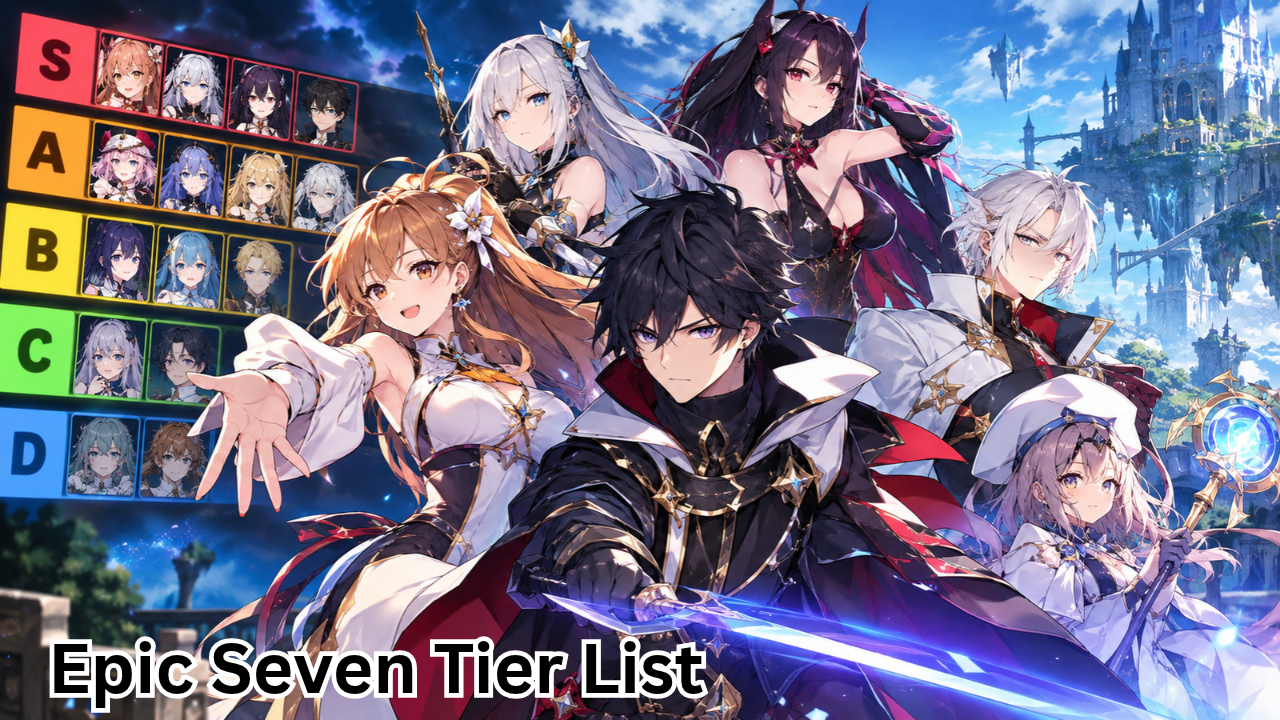
Choosing the right heroes can make a huge difference in Epic Seven. Whether you are a beginner building your first team, a returning player looking to improve your roster, or an experienced player preparing for competitive battles, knowing which heroes are worth investing in can save you valuable resources.
This Epic Seven tier list ranks heroes according to their general usefulness across different game modes, including PvE progression, Arena, Guild War, and World Arena. It also explains which characters are worth prioritizing and why some heroes perform better in specific situations than others.
One important thing to remember is that there is no single ranking that works perfectly for every account. Equipment quality, team composition, elemental matchups, and available upgrades can all influence a hero’s performance. A character ranked lower overall may still be the best choice for a particular battle.
Use this guide as a practical starting point for building a stronger roster and making smarter investment decisions.
What Is the Epic Seven Tier List?
An Epic Seven tier list is a ranking system that groups heroes according to their effectiveness, versatility, and value in different areas of the game. It helps players identify strong characters without spending resources on every hero they obtain.
Heroes are evaluated based on several factors:
- Overall performance: How effectively a hero contributes to winning battles.
- Versatility: Whether the hero is useful in multiple game modes.
- Team synergy: How well the character works with other heroes.
- Investment requirements: How much equipment, skill enhancement, and development the hero needs.
- Accessibility: How practical the character is for newer or free-to-play players.
- Current meta relevance: How well the hero performs against popular strategies and opponents.
Because Epic Seven receives balance adjustments and new hero releases, rankings can change over time. The following list is a general-purpose guide rather than a verified, live ranking of the October 2026 competitive meta.
Epic Seven Tier List: Hero Rankings
The table below provides a practical overview of notable heroes and their general strengths. These placements are intended as broad recommendations, not a definitive ranking based on current win rates.
| Tier | Hero | Main Strength | Best Use |
|---|---|---|---|
| S | Tamarinne | Powerful healing and team support | PvE boss battles |
| S | Iseria | Skill resets and utility | PvE teams and boss strategies |
| S | Specter Tenebria | Strong damage and survivability | PvE progression and selected PvP teams |
| S | Arbiter Vildred | Area damage and comeback potential | PvP and general progression |
| S | Apocalypse Ravi | Durability and sustained combat | Selected PvP matchups |
| A | Angelica | Reliable healing and protection | Early and mid-game PvE |
| A | Roana | Healing and counter-based support | Specific PvE and PvP matchups |
| A | Commander Lorina | Strong single-target damage | PvE bosses |
| A | Sigret | Boss damage and debuffs | Wyvern Hunt |
| A | Seaside Bellona | Area damage and debuff utility | Selected PvE and PvP content |
| B | Free Spirit Tieria | Accessible damage and farming utility | Early-game progression |
| B | Alexa | Accessible single-target damage | Early Wyvern teams |
| B | Karin | Damage and defense-break utility | Specific PvE team compositions |
| B | Crozet | Defensive support | Selected Hunt teams |
How to interpret these rankings: A hero’s tier depends on the game mode. Tamarinne, for example, is particularly valuable in many PvE encounters, but her PvE strengths do not automatically make her a top choice for every PvP battle. Similarly, a specialized Hunt hero can be more valuable than a broadly powerful character when building an efficient farming team.
The table is not an official Smilegate ranking, and the placements should not be treated as a confirmed snapshot of the current competitive environment.
S-Tier Heroes: High-Value Characters to Know
S-tier heroes are characters that can provide exceptional value in suitable teams. Some offer broad utility, while others excel in a particular role or matchup.
Tamarinne
Tamarinne is well known for her support capabilities in PvE. Her healing, team support, and ability to improve a team’s offensive performance make her an important character to understand when building teams for challenging encounters.
She can be especially helpful in longer boss fights where consistent recovery and team utility matter more than simply dealing maximum damage in the opening turn.
Why she is valuable:
- Provides substantial team support.
- Helps teams survive extended encounters.
- Can improve the effectiveness of damage dealers.
- Offers strong value in many PvE strategies.
Iseria
Iseria is a utility-focused Ranger whose skill-reset mechanic can enable powerful combinations. She becomes particularly interesting when paired with heroes whose skills have long cooldowns or whose effectiveness depends on using a key ability at the right moment.
Her value often comes from what she enables rather than from raw damage alone.
Best approach: Build a team around a clear plan for her skill reset instead of treating her as an interchangeable damage dealer.
Specter Tenebria
Specter Tenebria is a strong damage-oriented hero whose kit can reward careful positioning and team protection. She can be effective in PvE progression and certain PvP situations, especially when the opposing team struggles to remove her safely.
Her performance depends on equipment quality, team support, and the enemies she faces.
Key strengths:
- Strong damage potential.
- Useful performance in prolonged battles.
- Can benefit from protection and defensive support.
- Offers value across multiple types of content.
Arbiter Vildred
Arbiter Vildred is recognized for his area damage and ability to remain threatening after being defeated under the appropriate conditions. His kit can punish teams that lack a reliable answer to his revival or comeback mechanics.
He can be useful for players who want a damage dealer capable of pressuring multiple enemies.
However, his success depends on the opponent’s composition and available countermeasures. A strong hero is not necessarily an automatic win against every team.
Apocalypse Ravi
Apocalypse Ravi is associated with durable bruiser-style gameplay. Rather than relying exclusively on a fast opening attack, she can create pressure through survivability and sustained combat.
She is most attractive when a player wants a hero who can remain relevant in drawn-out fights. Her actual effectiveness depends on gear, matchup selection, and the surrounding team.
A-Tier Heroes: Reliable Choices for Specific Roles
A-tier heroes can be excellent investments, even when they are less universally applicable than the strongest options in a broad ranking.
Angelica
Angelica is a useful support option for newer players. Her healing and defensive capabilities can help teams survive encounters that would otherwise become difficult because of insufficient durability.
She is particularly relevant during early and mid-game progression, when equipment is limited and players may not yet have a wide selection of specialized supports.
Roana
Roana is a matchup-dependent support who can punish certain enemy mechanics while providing healing. She can be especially effective when opposing teams rely on attacks that trigger her passive effects.
Her usefulness illustrates why matchup knowledge matters. A hero with the right counter-mechanic can outperform a generally stronger character against a specific opponent.
Commander Lorina
Commander Lorina is a damage-focused option for players progressing through PvE. Her single-target damage makes her worth considering for encounters where eliminating one durable enemy is more important than hitting an entire team.
She is not a universal answer to every boss, but she can provide meaningful value when her strengths fit the encounter.
Sigret
Sigret is strongly associated with Wyvern Hunt teams. Her damage and debuff utility can contribute to faster, more consistent Hunt clears when paired with the right supporting heroes.
For players trying to build a reliable Wyvern team, a specialized hero such as Sigret may deserve more immediate investment than a character with a higher general-purpose tier.
Seaside Bellona
Seaside Bellona brings area damage and debuff utility that can be useful in suitable compositions. Her effectiveness varies with the encounter, enemy lineup, and equipment available.
She is an example of a hero whose historical reputation and recognizable kit should not replace checking whether she fits your current team-building needs.
Epic Seven PvE Tier List: Best Heroes for Story, Hunts, and Bosses
PvE content includes story missions, Hunts, Abyss, and other challenging encounters. The best heroes for these activities are often those who provide reliable healing, damage, debuffs, or specialized mechanics.
A hero’s usefulness in PvE should be judged by the specific challenge rather than by a universal ranking.
| PvE Activity | Heroes to Consider | What Matters Most |
|---|---|---|
| Story progression | Free Spirit Tieria, Angelica, Specter Tenebria | Reliable damage and survival |
| Wyvern Hunt | Sigret, Muwi, Furious, Angelica | Consistent debuffs and damage |
| General boss fights | Tamarinne, Iseria, Commander Lorina | Healing, utility, single-target damage |
| Longer encounters | Angelica, Tamarinne, Specter Tenebria | Sustain and consistent performance |
| Farming stages | Free Spirit Tieria, Vildred | Clear speed and efficient damage |
| Specialized challenges | Encounter-specific heroes | Mechanics, debuffs, and team synergy |
These are starting points rather than mandatory team compositions. Some heroes may require specific equipment, skill enhancements, or supporting units to perform well.
Best Heroes for Wyvern Hunt
Wyvern Hunt is an important progression goal because it helps players acquire equipment used to build many powerful heroes.
When building a Wyvern team, prioritize:
- Reliable debuffs that satisfy the Hunt’s mechanics.
- A frontline hero capable of surviving repeated attacks.
- Consistent damage rather than occasional high-damage turns.
- Sufficient Speed and effectiveness to make the team dependable.
- Equipment that matches the team’s requirements.
Sigret can be a strong damage dealer, while Muwi and Furious are useful options in suitable team compositions. Angelica can provide frontline durability for developing accounts.
Before investing heavily in an alternative team, check whether your current heroes can already meet the encounter’s requirements. A consistent, affordable team is often more valuable than an expensive composition that performs only slightly better.
Best Heroes for Story and General PvE
For story progression, a balanced team is usually more effective than a lineup made entirely of damage dealers.
A practical team structure includes:
- One durable frontline hero.
- One healer or defensive support.
- One primary damage dealer.
- One additional hero who provides damage, debuffs, or utility.
As you progress, adjust the composition to handle enemy mechanics. Some encounters reward area damage, while others require a reliable way to defeat one powerful target.
Epic Seven PvP Tier List: Arena, Guild War, and RTA
PvP rankings differ from PvE rankings because players must respond to opponents who use their own team combinations, equipment, and strategies.
A hero that performs exceptionally well against computer-controlled enemies may struggle against a carefully constructed PvP defense.
Recent tier-list coverage also highlights the importance of evaluating heroes separately for each mode. For example, the Epic7DB tier list provides separate PvP and PvE rankings, while Pocket Gamer’s Epic Seven tier list organizes characters by their effectiveness in different activities. Their rankings and update dates should be checked before making decisions about the latest meta. <Cite refs={[“turn666958search0″,”turn666958search1”]}/>
Heroes for Arena and Guild War
Arena and Guild War reward players who understand enemy defenses and build teams around specific win conditions.
Important hero roles include:
- Damage dealers: Eliminate priority targets or defeat multiple enemies.
- Tanks: Protect allies and help the team survive incoming damage.
- Healers: Restore health and provide defensive utility.
- Disruptors: Interfere with enemy turns, buffs, or skill usage.
- Bruisers: Combine damage and durability for extended fights.
Apocalypse Ravi, Roana, and Specter Tenebria can be useful in appropriate PvP matchups, but their effectiveness depends on the enemy lineup and the quality of their builds.
For offensive battles, do not choose heroes based on tier alone. Identify the opponent’s main threat, determine how your team will counter it, and select heroes that support that plan.
Heroes for Real-Time Arena (RTA)
Real-Time Arena requires a more flexible approach because opponents can adapt their drafts and remove important heroes through bans.
Successful drafting involves more than selecting the strongest characters available.
Consider the following principles:
- Build a balanced roster. Prepare damage dealers, supports, tanks, and counters rather than relying on one strategy.
- Understand your speed requirements. Fast openers can determine whether a team controls the opening turns.
- Avoid predictable drafts. A lineup that depends on one hero can become ineffective when that hero is banned.
- Learn counter-picks. Some heroes are valuable because they answer common enemy strategies.
- Invest in equipment. Strong base statistics and abilities cannot compensate for every weakness in a poorly equipped build.
The current competitive meta can shift after new releases and balance changes. For the latest character-specific placements, consult a recently updated RTA ranking rather than assuming that an older S-tier list remains accurate. <Cite refs={[“turn666958search2″,”turn666958search5”]}/>
How to Choose the Best Heroes for Your Account
A good Epic Seven tier list should help you decide where to invest, not simply tell you which heroes are popular.
1. Prioritize Your Current Progression Goal
If you are struggling with story missions, focus on survivability and reliable damage. If your equipment farming is inefficient, build a Hunt team. If you already have stable PvE teams, you can devote more resources to PvP specialists.
Your immediate bottleneck should determine your next investment.
2. Consider Equipment Before Chasing Higher Tiers
Equipment plays a major role in hero performance. A well-built A-tier character can outperform a poorly equipped S-tier hero in the right situation.
Pay attention to the statistics your hero needs, including Speed, Critical Hit Chance, Critical Hit Damage, Health, Defense, and Effectiveness.
Not every hero needs the same combination. Select equipment according to the character’s role and abilities.
3. Build Teams, Not Just Individual Heroes
A collection of powerful heroes does not automatically create a powerful team.
For example, three damage dealers with no reliable healing or protection may struggle against a difficult boss. Likewise, a PvP team with excellent defensive heroes may fail if it cannot deal enough damage to finish the battle.
Aim for complementary abilities rather than simply selecting the highest-ranked characters.
4. Avoid Spending Resources on Every New Hero
Epic Seven offers many characters, but developing every hero requires substantial resources.
Before committing to a new character, ask yourself:
- Does this hero fill a gap in my roster?
- Can I equip the hero properly?
- Is the character useful in content I regularly play?
- Do I already own someone who performs a similar role?
- Will investing in this hero delay a more important upgrade?
These questions help prevent unnecessary spending and make progression more manageable.
Common Mistakes When Using an Epic Seven Tier List
Even a well-researched ranking can lead to poor decisions when interpreted incorrectly.
Treating every tier as universal: A hero’s PvE value may differ substantially from their RTA value.
Ignoring gear quality: Equipment can determine whether a character reaches the Speed, damage, or durability needed for a role.
Copying high-rank teams too early: Competitive teams may depend on rare heroes, carefully tuned equipment, and substantial roster depth.
Ignoring team synergy: A hero’s abilities should complement the rest of the team.
Following outdated rankings: New heroes, buffs, nerfs, and balance adjustments can change character priorities.
Investing based only on rarity: A rare hero is not automatically the best choice for your immediate objective.
The most effective approach is to use tier lists as guidance, test heroes in the content you play, and adjust your roster as your equipment and progression improve.
Frequently Asked Questions (FAQs)
1. Who is the best hero in Epic Seven?
There is no single best hero for every situation. Tamarinne is a valuable PvE support, while heroes such as Apocalypse Ravi and Specter Tenebria can be useful in suitable PvP matchups. The best choice depends on your game mode, equipment, and team composition.
2. Which heroes should beginners build first?
Beginners should prioritize heroes that support story progression and equipment farming. Angelica, Free Spirit Tieria, and suitable Wyvern Hunt heroes can be useful starting points. Focus on building a reliable team before investing heavily in specialized PvP characters.
3. Is the Epic Seven tier list the same for PvE and PvP?
No. PvE focuses on clearing stages, defeating bosses, and farming equipment, while PvP requires counter-picks, effective speed tuning, and strategies against other players. Always check rankings for the specific game mode you want to improve.
4. Which heroes are best for Wyvern Hunt?
Sigret, Muwi, Furious, and Angelica are options worth considering when building a Wyvern team. The ideal lineup depends on your available heroes, equipment, and ability to meet the Hunt’s mechanics consistently.
5. Do tier lists change after updates?
Yes. New hero releases, balance adjustments, equipment changes, and shifts in competitive strategies can affect rankings. Check recently updated tier lists before making major investment decisions, especially for competitive PvP.
6. Can lower-tier heroes still be worth building?
Absolutely. Some heroes excel in specific encounters or provide unique abilities that your roster needs. A lower-ranked hero can be a better investment than a higher-ranked alternative if they fit your team and help you complete important content.
Final Thoughts
The Epic Seven tier list is a useful resource for identifying promising heroes, planning team compositions, and deciding where to invest your development materials. However, rankings should be treated as guidance rather than strict rules.
For PvE, prioritize reliable progression, effective Hunt teams, and heroes who help you overcome difficult encounters. For PvP, focus on flexible team compositions, matchup knowledge, equipment quality, and understanding the current competitive environment.
Most importantly, build around your own roster and goals. A carefully developed team with strong synergy will often deliver better results than a collection of highly ranked heroes without the equipment or support they need.
As the game evolves, revisit current rankings and adjust your priorities when necessary. By combining tier-list recommendations with practical experience, you can develop a stronger roster and enjoy more consistent progress in Epic Seven.
Also Read : Sims 3 Mods: The Ultimate Guide to Enhancing Your Gameplay in 2026










Leave a Reply